Gemini 4 Hydrogen vs Opus 5.5: 2.7x Cheaper per Token, but Should You Swap It Into Your Agent?
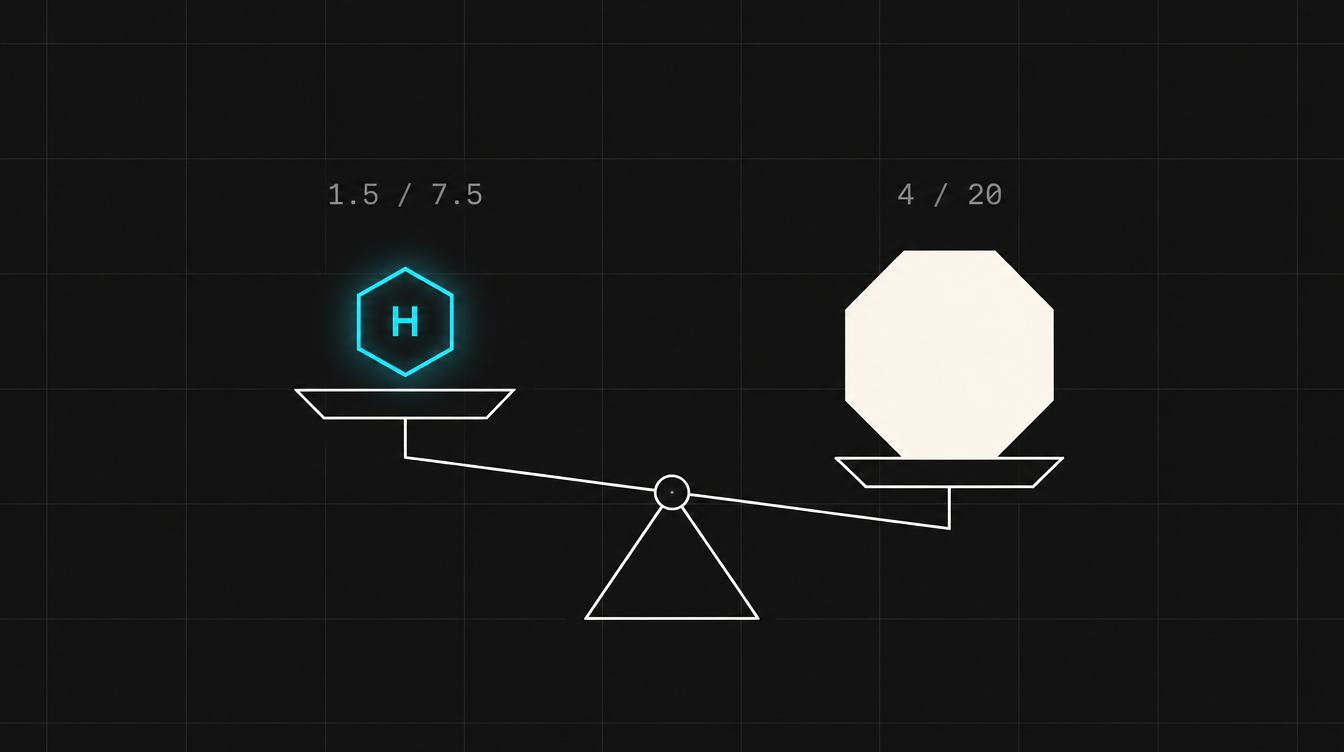
In Gemini 4 Hydrogen vs Opus 5.5, the price-sheet math is simple: Hydrogen costs US$ 1.50 per million input tokens and US$ 7.50 per million output tokens. Opus 5.5 costs US$ 4 and US$ 20.
2.7x cheaper. On both ends.
Google launched Hydrogen on November 12 as the "fast" model of the Gemini 4 family, the successor to the Flash line. And the timeline did what the timeline does: there's already a Reddit post saying it "destroyed Fable 5.2 and every other model."
It didn't.
But it's not a second-tier model either. According to Google, it beats Gemini 4 Argon on the Artificial Analysis index while charging less, and it runs on the API free tier.
In this post I put Hydrogen's numbers side by side with Opus 5.5, separating Google's own table from independent measurements. I run the math on an agentic session with caching, show where Opus still holds, explain which Gemini 4 to use for what, and close with a Laravel fallback that switches models via .env, plus the list of what breaks when you switch.
TL;DR
- What it is: Gemini 4 Hydrogen, the fast and cheap model of the Gemini 4 family, released on 11/12/2026. Model id
gemini-4-hydrogen. - Price: US$ 1.50 input, US$ 0.075 cached and US$ 7.50 output (thinking included) per million tokens, flat across the full 1M window. Opus 5.5: US$ 4/20.
- Free tier: yes, on the API, but on the free plan your data is used for training. It's also the model behind Google Search and the auto-select in the Gemini app.
- Where Opus holds: agentic coding and computer use. Hydrogen wasn't built to replace Opus in your coding agent. It was built to be the cheap executor.
- Useful link: Google's official announcement.
Is Gemini 4 Hydrogen free?
Depends on where you use it.
In the Gemini app and Google Search, yes. According to the announcement, Hydrogen already powers Search for all users and shows up in the app's model picker. Free-plan users get it through auto-select.
On the API, there's a free tier. The AI Studio pricing page lists input, output and cache as "free of charge" on the free plan. Carbon and Argon have no free tier. Hydrogen is the only Gemini 4 you can test without a credit card.
Two caveats that matter if you're thinking about production:
- On the free tier, your data is used to improve Google's products. On the paid plan, it isn't. If you're sending client code or personal data, the free tier is off the table. That's compliance, not opinion.
- Google hasn't published Hydrogen's free-tier RPM and RPD in text. The rate limits page tells you to check your project's limit directly in AI Studio. In other words: fine for testing, not for capacity planning.
And in Antigravity, Google's coding agent, Hydrogen is the default model, but only for paid AI Pro and Ultra subscribers.
On the paid plan, the full table:
| Mode | Input | Cache | Output |
|---|---|---|---|
| Standard | US$ 1.50 | US$ 0.075 | US$ 7.50 |
| Batch and Flex | US$ 0.75 | US$ 0.0375 | US$ 3.75 |
| Priority | US$ 2.70 | US$ 0.135 | US$ 13.50 |
Prices per million tokens, per the pricing page. No long-context tier: the same price applies from 1 token to 1,048,576.
Gemini 4 Hydrogen vs Opus 5.5 on benchmarks
There's a catch here that most comparisons will ignore.
Google didn't compare Hydrogen against Opus 5.5. The model card puts Hydrogen against Claude Sonnet 5.5 and GPT-6.1 Terra, which are in its price bracket. And Anthropic, of course, didn't compare Opus against Hydrogen either.
So to build the side-by-side I crossed Google's model card table with the Fable 5.2 announcement table, where Anthropic published Opus 5.5's numbers. Only benchmarks with the same name in both tables make the cut:
| Benchmark | Gemini 4 Hydrogen | Claude Opus 5.5 | Source |
|---|---|---|---|
| Terminal-Bench-Science 0.1 | 51.4% | 58.7% | Google model card / Anthropic announcement |
| OSWorld 2.1 (computer use) | 77.6% (offline subset) | 87.2% | Google model card / Anthropic announcement |
| Artificial Analysis Intelligence Index | 51 (high) / 54 (xhigh) | 59 (max) | Google / Artificial Analysis |
Read this table carefully. Different harness, different lab, and on OSWorld Google ran an offline subset. It's not a lab-grade comparison. It's the best you can do with what's been published.
Even with that discount, the picture is clear: Opus 5.5 leads where your coding agent lives. 7 points on Terminal-Bench-Science. Almost 10 on computer use. And 5 to 8 points on the Artificial Analysis aggregate index.
Now the part where Hydrogen surprises. Against its own price bracket, on the model card:
| Benchmark | Hydrogen | Sonnet 5.5 | GPT-6.1 Terra |
|---|---|---|---|
| Terminal-Bench 4.1 | 57.0% | 63.9% | — |
| Agents' Last Exam v1.1 | 71.6% | 60.4% | 69.8% |
| AutomationBench-AA | 76.1% | 71.8% | 60.2% |
| HLE-Diamond | 58.8% | 53.3% | 47.3% |
| OSWorld 2.1 (offline) | 77.6% | 83.9% | 74.2% |
Interesting pattern. Hydrogen wins on reasoning, workflow automation and generic agent tasks. It loses to Sonnet 5.5 on terminal and computer use. Again: the Claude side holds on code and machine work.
And the jump from its predecessor is real: on Terminal-Bench 4.1, Hydrogen scores 57% against 18.2% for Gemini 3.8 Flash, according to Google. More than triple.
What's Google's number and what's independent
So you don't get sold a pig in a poke:
- Artificial Analysis index of 51/54: a number Google cites in the announcement. The public Artificial Analysis page I could read shows Opus 5.5 (max) at 59 and Gemini 4 Carbon at 60, but Hydrogen's score only appears in a chart. Treat 51/54 as Google's claim until AA confirms it in text.
- "More than 5x fewer hallucinations" than 3.8 Flash, 94% honesty: Google's internal eval. No independent measurement yet.
- "2.5x faster" than 3.8 Flash: from Google. Partners quoted in the announcement report 2x to 2.8x faster with 12% to 23% fewer tokens, but that's partner-reported, not a benchmark.
- Time per task: this one is from Artificial Analysis: 1.4 minutes per task for Hydrogen at low effort.
And that viral post saying Hydrogen "destroyed Fable 5.2"? No published benchmark backs it up. Fable 5.2 scores 65 on the Artificial Analysis index. Hydrogen, in Google's own best case, 54.
Cost per task: the math on an agentic session
Price per token doesn't pay the bill. Cost per resolved task does.
I'll use the same simulation from the Fable 5.2 vs Opus 5.5 comparison: a coding agent with a 120k-token cached prefix (system prompt, tools, project files), 200 turns, 3k new input tokens and 2k output tokens per turn.
One billing difference: Hydrogen has no explicit cache. It uses implicit caching, with no write fee and a 95% discount on cache reads for prefixes of 4,096 tokens or more, per the AI Studio docs. So the first call pays for the full prefix at the regular input price.
| Line | Gemini 4 Hydrogen | Claude Opus 5.5 |
|---|---|---|
| First prefix write (120k) | US$ 0.18 | US$ 0.60 |
| Cache reads (200 x 120k = 24M) | US$ 1.80 | US$ 4.80 |
| New input (600k) | US$ 0.90 | US$ 2.40 |
| Output (400k) | US$ 3.00 | US$ 8.00 |
| Total | US$ 5.88 | US$ 15.80 |
2.7x cheaper. Matches the price sheet.
But this math assumes both models burn the same tokens and solve the same tasks. They don't. Two variables change the game:
1. Thinking tokens. Hydrogen's default effort is high, and thinking is billed as output. If Hydrogen needs twice the output to reach the result, the bill goes to US$ 8.88. Still cheaper. Break-even only happens if Hydrogen spends 4.3 times more output tokens than Opus on the same task. That's a lot of slack.
One reference point, from a single test: Simon Willison ran the same prompt on both Gemini 4 models. Hydrogen on high used 5,311 tokens, 3.99 cents and 19 seconds. Carbon on high used 20,305 tokens, 20.31 cents and 4 minutes. One prompt isn't a benchmark, but it shows Hydrogen isn't a verbose model.
2. Success rate. This is the argument for Opus. If Hydrogen solves 51 out of 100 terminal tasks and Opus solves 59, the failed task isn't free: there's retry, there's human review, there's a bug that ships to production. In a coding agent, one percentage point of accuracy can be worth more than the token savings.
What about the Claude plan subsidy?
There's a claim going around on X that on a Claude subscription, Opus comes out "66x subsidized" versus API pricing, while Hydrogen on Antigravity would be "17x." That's one user's opinion, not data from Anthropic or Google, and I couldn't verify the methodology.
But the reasoning behind it holds: if you use Opus through Claude Code on a Max plan, you're not paying US$ 4/20. You pay the subscription. Per-token price comparisons only make sense if you run via API, in production, inside your own product. For your personal coding assistant, the math is different.
Do not just follow the news — master it. Hands-on AI Engineering, live, every week, in the largest community in Brazil.
Join the ClãHydrogen vs Argon vs Carbon: which Gemini 4 to use for what
The blog has already covered the two older siblings: Gemini 4 Carbon, the flagship, and Gemini 4 Argon vs Opus 5.5. With Hydrogen, the family is complete:
| Carbon | Argon | Hydrogen | |
|---|---|---|---|
| Role | flagship | fast, fewer tokens per turn | cheap executor, free tier |
| Price through 11/30 | US$ 2/10 | US$ 2/10 | US$ 1.50/7.50 |
| Price from 12/1 | US$ 4/20 | US$ 4/20 | US$ 1.50/7.50 |
| API free tier | no | no | yes |
| Artificial Analysis index | 60 | 50 (per Google) | 51 to 54 (per Google) |
Prices from the AI Studio pricing page. The row that matters is December.
On December 1, Carbon and Argon double in price and tie with Opus 5.5. Hydrogen has no increase scheduled in the table. From then on, Argon stops making sense: Hydrogen scores the same or higher on the index, per Google, at 37.5% of the price.
In practice:
- Carbon: when you want the best Gemini and accept paying Opus prices. Compare it with Opus on your eval, not on the index.
- Argon: only worth it until 11/30, if you already had an integration and are in a trial period. After that, migrate to Hydrogen or Carbon.
- Hydrogen: the executor. Classification, extraction, summarization, sub-agents that run many times, RAG with large context. Google itself shows this in Antigravity: the Orchestrator pairs Carbon planning with Hydrogen executing, and gets close to pure Carbon on Terminal-Bench 4.0 using 24% less quota, according to the announcement.
Notice the pattern. It's exactly the advisor/orchestrator setup Anthropic sold with Fable 5.2. The expensive model decides, the cheap model executes. The fight is no longer "which model is best." It's "which combination is cheapest per resolved task."
Laravel fallback: swapping Opus for Hydrogen via .env
If you want to test Hydrogen in your product without rewriting anything, the way to go is to isolate the provider behind an interface and switch by config.
The .env:
LLM_PROVIDER=gemini
GEMINI_API_KEY=sua-chave
GEMINI_MODEL=gemini-4-hydrogen
GEMINI_THINKING_LEVEL=medium

ANTHROPIC_API_KEY=sua-chave
ANTHROPIC_MODEL=claude-opus-5-5
The config/llm.php:
<?php

return [
    'provider' => env('LLM_PROVIDER', 'anthropic'),

    'gemini' => [
        'key' => env('GEMINI_API_KEY'),
        'model' => env('GEMINI_MODEL', 'gemini-4-hydrogen'),
        'thinking_level' => env('GEMINI_THINKING_LEVEL', 'high'),
    ],

    'anthropic' => [
        'key' => env('ANTHROPIC_API_KEY'),
        'model' => env('ANTHROPIC_MODEL', 'claude-opus-5-5'),
    ],
];
The client, with Hydrogen as primary and Opus as fallback when Google fails:
<?php

namespace App\Services\Llm;

use Illuminate\Http\Client\RequestException;
use Illuminate\Support\Facades\Http;
use Illuminate\Support\Facades\Log;

class LlmClient
{
    public function complete(string $system, string $prompt): string
    {
        $primary = config('llm.provider');
        $fallback = $primary === 'gemini' ? 'anthropic' : 'gemini';

        try {
            return $this->call($primary, $system, $prompt);
        } catch (RequestException $e) {
            Log::warning('LLM primário falhou, usando fallback', [
                'primary' => $primary,
                'status' => $e->response?->status(),
            ]);

            return $this->call($fallback, $system, $prompt);
        }
    }

    private function call(string $provider, string $system, string $prompt): string
    {
        return $provider === 'gemini'
            ? $this->gemini($system, $prompt)
            : $this->anthropic($system, $prompt);
    }

    private function gemini(string $system, string $prompt): string
    {
        $model = config('llm.gemini.model');

        $response = Http::timeout(120)
            ->withHeaders(['x-goog-api-key' => config('llm.gemini.key')])
            ->post("https://generativelanguage.googleapis.com/v1beta/models/{$model}:generateContent", [
                'systemInstruction' => ['parts' => [['text' => $system]]],
                'contents' => [['role' => 'user', 'parts' => [['text' => $prompt]]]],
                'generationConfig' => [
                    // Hydrogen ignora temperature/top_p/top_k e rejeita thinking_budget.
                    'thinkingConfig' => ['thinkingLevel' => config('llm.gemini.thinking_level')],
                ],
            ])
            ->throw();

        return collect($response->json('candidates.0.content.parts', []))
            ->reject(fn ($part) => $part['thought'] ?? false)
            ->pluck('text')
            ->implode('');
    }

    private function anthropic(string $system, string $prompt): string
    {
        $response = Http::timeout(120)
            ->withHeaders([
                'x-api-key' => config('llm.anthropic.key'),
                'anthropic-version' => '2023-06-01',
            ])
            ->post('https://api.anthropic.com/v1/messages', [
                'model' => config('llm.anthropic.model'),
                'max_tokens' => 8000,
                'system' => $system,
                'messages' => [['role' => 'user', 'content' => $prompt]],
            ])
            ->throw();

        return collect($response->json('content', []))
            ->where('type', 'text')
            ->pluck('text')
            ->implode('');
    }
}
Change LLM_PROVIDER in .env, run php artisan config:clear, and you've switched models. The fallback covers outages and 5xx errors. It doesn't cover bad answers: for that you need evals, not try/catch.
What breaks when you switch
If you're coming from Gemini 3.8 Flash, or if your code was written with Claude in mind, pay attention. The official list of changes and the Agent Platform guide include:
temperature,top_pandtop_kare ignored. Out-of-range values return 400. If you controlled determinism with temperature, you lost that lever.thinking_budgetand theminimallevel return 400. There are now only four levels:low,medium,high(default) andxhigh. The default moved frommediumtohigh, meaning more thinking tokens by default.- Explicit caching was removed. If you used
cachedContentsorcaches.create, it breaks. Only implicit caching remains, now kicking in from 4,096 tokens. frequency_penalty,presence_penaltyandcandidate_countgreater than 1 return 400.- Prefilling the model turn isn't supported. That trick of starting the assistant's reply with
{to force JSON, common in code written for Claude, doesn't work here. - Stricter thought signatures. Editing the prefix of a conversation on the same model returns 400 unless you pass
prefix_mismatch_behavior="DROP". - Tools must be declared natively. A tool described only in the prompt gets
MALFORMED_FUNCTION_CALL. - Unified window. Instead of separate 1M input and 64K output budgets, there's now a single 1,048,576-token window for input, thinking and output. Synchronous output goes up to 65,536 tokens.
And two lifecycle details: Hydrogen is a short-term GA, with a minimum 45-day notice before retirement, per the Agent Platform guide. And the knowledge cutoff is March 2026, according to the model card.
Limitations and caveats
There's no official Hydrogen vs Opus 5.5 benchmark. The comparison in this post crosses Google's table with Anthropic's. Different harness, different configuration. Use it as direction, not as a verdict.
The hallucination and honesty numbers are Google-internal. Until an independent evaluation comes out, they're claims.
The free tier trains on your data. For production with sensitive data, paid plan only.
No image or audio generation and no Live API. Hydrogen reads text, image, video, audio and PDF, but only outputs text.
More models are coming. Word on X is that a "Gemini 4 Oxygen," the next Flash-line checkpoint, is already showing up on LMArena. It's a RUMOR: Google hasn't confirmed it. If it ships, this post gets updated.
Quick FAQ
What is Gemini 4 Hydrogen? It's the fast and cheap model of Google's Gemini 4 family, successor to the Flash line, released on 11/12/2026. It was adapted from Gemini 4 Carbon, has a 1M-token window and runs in Google Search, the Gemini app and the API.
Is Gemini 4 Hydrogen better than Opus 5.5? No. On comparable benchmarks, Opus 5.5 leads: 58.7% vs 51.4% on Terminal-Bench-Science and 87.2% vs 77.6% on OSWorld 2.1. Hydrogen wins on price: 2.7x cheaper per token.
How much does Gemini 4 Hydrogen cost? US$ 1.50 per million input tokens, US$ 0.075 cached and US$ 7.50 output, flat across the whole 1M window. Batch and Flex cost half.
Is Gemini 4 Hydrogen free? In the Gemini app and Google Search, yes. The API has a free tier, but free-plan data is used for training.
What's the Gemini 4 Hydrogen model id?
gemini-4-hydrogen.
Should I swap Opus 5.5 for Hydrogen in my coding agent? For a coding agent, probably not: that's exactly where Opus holds. For high-volume work (classification, extraction, executor sub-agents), it's worth testing. Run 20 real tasks on both and measure cost per resolved task.
Conclusion
Gemini 4 Hydrogen isn't an Opus 5.5 at half the price. It's a model from a different category that got close enough to mess up the math.
For the coding agent that works in the terminal and needs to get it right the first time, Opus 5.5 is still ahead, and the error costs more than the token. For high-volume work, Hydrogen at US$ 1.50/7.50 just became the market's new price floor. And on December 1 it gets even more isolated, when Argon and Carbon double in price.
The right question isn't "Hydrogen or Opus." It's which part of your pipeline needs Opus. Whoever answers that with evals will pay a fraction of the bill. Whoever answers on gut feeling will switch models every week, with every viral post.

{AI Engineer} — apaixonado por Laravel, arquitetura de software e construir produtos com impacto. Compartilho aqui tutoriais, descobertas e reflexões sobre o dia a dia de engenharia.
There is no shortage of content. What is missing is someone to untangle it: what matters now is how to implement it the right way. In the Clã you get that live, every week, with people who have already filtered out the noise.
Join the Clã