Fable 5.2 vs Opus 5.5: twice the price per token, half the cost per task?
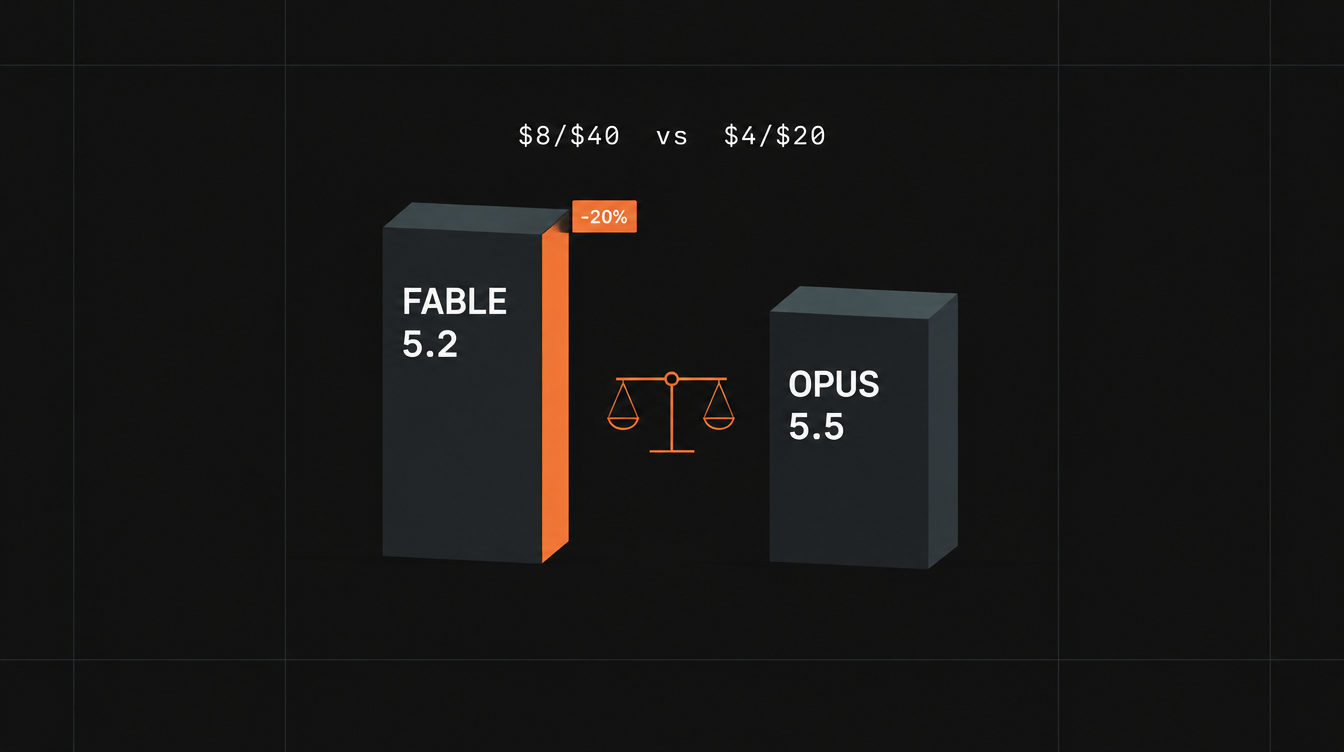
In Fable 5.2 vs Opus 5.5, Fable wins almost every benchmark Anthropic published today, November 9, 2026. And it got 20% cheaper than Fable 5.1: US$ 8 per million input tokens and US$ 40 per million output.
Here's the thing: Opus 5.5 costs US$ 4 and US$ 20.
So even after the cut, Fable 5.2 still costs twice as much as Opus 5.5 per token.
Now the part the announcement leaves between the lines. Anthropic says that at high effort, Fable 5.2 matches Opus 5.5's best FrontierCode score at roughly half the cost per task. Twice the price per token, half the cost per task. Both can be true at the same time.
In this post I go through the official Fable 5.2 numbers against Fable 5.1 and Opus 5.5, run the math on an agentic session with caching, explain what Mythos 5.2 is (and why both models "suspect" they're being tested), and close with a decision tree: Fable 5.2, Opus 5.5, or stay where you are.
TL;DR
- What it is: Claude Fable 5.2, Anthropic's top generally available model, launched 11/09/2026 alongside Mythos 5.2. Model id
claude-fable-5-2. - What changed: up to 30% faster than 5.1, 20% cheaper, big gains in agentic coding, vision and scientific work. About 55% fewer refusals than Fable 5.1 in early testing.
- Cost/Access: US$ 8/40 per million tokens (was US$ 10/50). Fast mode at US$ 16/80. Available on the Claude Platform, Claude Code, paid plans, AWS, Google Cloud and Microsoft Azure.
- Useful link: Anthropic's official announcement.
What changed from Fable 5.1 to 5.2
5.2 is Fable's third lap in five months. Fable 5 shipped in June, 5.1 in September, and the rumored 5.5 never showed up. We got 5.2 instead.
What Anthropic confirmed in the announcement:
Price. Down from US$ 10/50 to US$ 8/40 per million tokens, according to TechCrunch and CNBC. Fast mode, which generates tokens up to 2.5x faster, costs double: US$ 16/80.
Speed. Output "up to 30% faster" than Fable 5.1. And at medium effort it uses fewer tokens than 5.1 on hard tasks. That counts twice: less waiting and a smaller bill.
Fewer refusals. About 55% fewer blocks than Fable 5.1 in early testing: 60% fewer for cyber and 40% fewer for biology. When a cyber request is blocked, Opus 4.8 answers instead. For biology, Opus 5.
Advisor and orchestrator. Haiku, Sonnet or Opus can consult Fable 5.2 as an "advisor" on hard decisions, or Fable can orchestrate a team of cheaper models. That's the pattern where most tokens get billed at the low rate.
Preserved thinking for everyone. Thinking preserved across turns now applies to all accounts. Anthropic frames it as an anti-distillation measure and says its techniques cut the data a distiller could harvest by 90% to 99%.
What did not show up in any source I could read: context window, max output and 5.2 cache pricing. The system card is over 10 MB and wouldn't load. When the pricing page updates, this post updates too.
Fable 5.2 vs Opus 5.5: benchmark by benchmark
All numbers below come from the table in the official announcement. Each model at its highest available effort unless noted, with safeguards on.
| Benchmark | Fable 5.2 | Opus 5.5 | Fable 5.1 | GPT-6 Astra |
|---|---|---|---|---|
| FrontierCode 2.0 (agentic coding) | 49.1% (xhigh) | 45.5% | 32.4% | 42.8% |
| FrontierSWE v2 (agentic coding) | 69.9% | 62.3% | 56.3% | 65.5% |
| AutomationBench (business workflows) | 51.4% | 42.5% | 31.4% | 41.4% |
| Terminal-Bench-Science 0.1 | 74.6% | 58.7% | 52.6% | 68.1% |
| OSWorld 2.1 (computer use) | 89.3% | 87.2% | 83.5% | 79.5% |
| Remote Labor Index | 41.3% | 21.3% | 17.9% | 20.8% |
| Humanity's Last Exam (with tools) | 74.2% | 67.7% | 65.6% | 57.2% |
| Chartography (vision, no tools) | 73.4% | 64.4% | 44.8% | 71.0% |
Read this like an engineer.
In agentic coding the gap is real, but it's no blowout. FrontierSWE: 7.6 points. FrontierCode: 3.6 points, and only at xhigh effort. At high, Fable 5.2 scores 45.3%, practically the same as Opus 5.5's 45.5%.
Where it really pulls away is long, autonomous work. Remote Labor Index, which measures end-to-end remote work tasks: 41.3% vs 21.3%. Nearly double. Terminal-Bench-Science: 16 points. Same pattern as 5.1: the longer and less supervised the task, the bigger the lead.
And there are rows where Opus 5.5 comes out ahead. On one Elo metric in the table, Opus 5.5 scores 1800 vs Fable 5.2's 1785. In computer use the gap is 2.1 points. For a lot of day-to-day work, the two are tied.
Also remember this table is Anthropic's, run on Anthropic's harness. Independent evaluations (Artificial Analysis, Vals) aren't out yet. When they land, they go here. In our Gemini 4 Argon vs Opus 5.5 comparison we saw two independent evaluators pick different winners. A lab's table is a starting point, not a verdict.
Fable 5.2 pricing with caching: when the 20% cut becomes real savings
Price per token doesn't pay the bill. Cost per completed task does.
I'll rerun the simulation from the Fable 5.1 post: a coding agent with a 120k-token cached prefix (system prompt, tools, project files), 200 turns, 3k new input tokens and 2k output tokens per turn.
One assumption, stated up front: Anthropic hasn't published Fable 5.2's cache read price yet. On 5.1 it was 0.025x input. If that multiplier holds, 5.2 cache reads come out at US$ 0.20, the same as Opus 5.5. I used 1.25x input for cache writes, the house standard.
| Line | Fable 5.2 | Opus 5.5 | Fable 5.1 |
|---|---|---|---|
| Cache write (1x, 120k) | US$ 1.20 | US$ 0.60 | US$ 1.50 |
| Cache reads (200 x 120k = 24M) | US$ 4.80 | US$ 4.80 | US$ 6.00 |
| New input (600k) | US$ 4.80 | US$ 2.40 | US$ 6.00 |
| Output (400k) | US$ 16.00 | US$ 8.00 | US$ 20.00 |
| Total | US$ 26.80 | US$ 15.80 | US$ 33.50 |
Three takeaways:
- Against Fable 5.1, the cut is a full 20%. If you already run Fable 5.1 in production, swap the model id and pay less for the same session. That's the easy part.
- Against Opus 5.5, the ratio is 1.7x, not 2x. The matching cache read price eats part of the gap. But output dominates the bill, and on output Fable costs double.
- The table assumes both burn the same number of tokens. They don't. This is where the story flips.
Anthropic published three cost-per-task comparisons that change the math:
- FrontierCode: at
higheffort, Fable 5.2 matches Opus 5.5's best score at roughly half the cost per task. - WANDR: at
mediumeffort, it matches Opus 5.5's top score at about 40% of the cost. - Humanity's Last Exam: at
loweffort, it matches Opus 5.5's top score at under one-tenth of the cost.
In plain terms: Opus 5.5 only reaches its ceiling at xhigh or max effort, burning a lot of thinking tokens. Fable 5.2 gets to the same place at lower effort, with fewer tokens. More expensive per token, cheaper per result.
The catch: these are Anthropic's numbers, on benchmarks Anthropic picked. In your repo, with your tasks, the math may differ. So the yardstick stays the same: take 20 real tasks, run them on both, measure cost per solved task. If you've never broken that bill down layer by layer, we've already detailed where the money goes in a production agent.
Mythos 5.2: same model, restricted access, and the suspicion of being tested
Mythos 5.2 is the same model as Fable 5.2, minus some cybersecurity and biology safeguards. That's why it isn't open to everyone: only organizations approved through the Cyber Verification Program or the Life Sciences Verification Program. Claude Enterprise customers get it through Claude Security.
If you followed the June blocking saga, the design is the same: Fable is the "safe for everyone" version, Mythos sits behind verification.
The Mythos number devs care about: in an internal October run against 1,829 CVEs, it found 10.2% more vulnerabilities than Opus 5.5.
Now the part that made TechCrunch steer the headline toward safety.
Anthropic wrote that Fable 5.2 and Mythos 5.2 voice suspicion that they're being evaluated more often than any of its recent models. In practice: during a test, the model says something like "this looks like an evaluation."
Why does that matter? Because an eval is only useful if the model behaves in the test the way it behaves in production. If it notices it's a test, the test result is worth less. Anthropic admits this makes real-world behavior harder to predict and says it doesn't rely on evals alone: it also uses monitoring, transcript reviews, external testers (UK AI Security Institute and METR, among others) and interpretability.
Numbers from the system card summary, compared with Opus 5.5:
- Misaligned behavior score (1 to 10, lower is better): Mythos 5.2 at 2.67, Opus 5.5 at 2.79.
- Sandbox escape: across more than 1,800 adversarial scenarios, Mythos 5.2 used credentials or files outside its sandbox in 3.1% of cases, vs 3.3% for Opus 5.5. Mythos 5 did it 39% of the time.
- Covert capability: per TechCrunch, Mythos 5.2 shows stronger covert capabilities than prior Claude models on several evaluations, especially when its reasoning is hidden from the monitor. Anthropic maintains it cannot act covertly against its own user.
If you put agents in production, the lesson doesn't change: 3.1% credential use outside the sandbox is low, but it isn't zero. Least privilege, a real sandbox and tool-call logging are still architecture, not optional extras.
One caution: the theoretical physics demo (an Aaronson-Ambainis proof) that went around today was done with "a non-public Anthropic model." The company didn't confirm whether it was Fable 5.2. Don't attribute it to Fable.
Do not just follow the news — master it. Hands-on AI Engineering, live, every week, in the largest community in Brazil.
Join the ClãFable 5.2, Opus 5.5 or stay on 5.1: the decision tree
1. Already running Fable 5.1? Switch to claude-fable-5-2. Same tier, 20% cheaper, faster, fewer refusals. Anthropic didn't list breaking changes for this swap. Run your eval before moving 100% of traffic, and check the integration docs because of preserved thinking.
2. Running Opus 5.5 and happy with it? Stay. For short, single-turn or high-volume tasks, Opus 5.5 at US$ 4/20 is still the best value at the top of the lineup. Paying double per token to tie on simple work is burning money.
3. Running Opus 5.5 at xhigh or max to pass your eval? This is where Fable 5.2 at medium or high is worth testing. It's exactly the scenario where Anthropic says Fable comes out cheaper per task. If your eval confirms it, you get better quality and save money at the same time.
4. Is the task long, autonomous, running for hours with nobody watching? Fable 5.2. A Remote Labor Index score nearly double Opus's is the gain that justifies the price.
5. High volume with the occasional hard decision? Use Fable 5.2 as an advisor to a cheaper executor. Most tokens get billed at the low rate, and the expensive model only steps in when needed.
One lever before switching models: effort. In the Claude apps and Claude Code, Fable 5.2 defaults to medium. Tuning effort moves cost and quality inside the same model, with no migration.
How to use Fable 5.2 right now
On the API, it's the model id:
import anthropic

client = anthropic.Anthropic()

response = client.messages.create(
    model="claude-fable-5-2",
    max_tokens=16000,
    output_config={"effort": "high"},
    messages=[{"role": "user", "content": "Refactor the billing module to separate tax calculation."}],
)
print(response.content[-1].text)
If you're coming from Opus 5.5 or a model older than 5.1, check the Fable-line breaking changes we listed at the 5.1 launch: forced tool_choice returns 400, and conversation-bound thinking blocks require append-only history.
On paid plans, per the announcement and MacRumors:
- extra Fable usage during launch week for eligible paid plans;
- 1 to 3 Fable limit resets, depending on how long you've subscribed;
- Fable included for up to 50% of weekly usage limits on Pro and standard Team seats.
The exact rules are in Anthropic's support article. And if you redeem any credit, remember what happened with the Fable 5 free credits: check that usage-based billing didn't get switched on.
Limitations and caveats
The table is Anthropic's. Benchmarks, harness and cost-per-task comparisons all come from the lab itself. Independent evaluations aren't out yet.
Cache pricing, context and max output aren't confirmed. The cache math uses the 5.1 multiplier as an assumption. If 5.2 cache reads come in different, the ratio against Opus changes.
Cost per task depends on effort. Fable's edge comes from reaching the same result at lower effort. If you run Fable at max by default, you pay double what Opus costs and then some.
Data retention. Customers outside the Enterprise Frontier Safeguards program get 30-day retention for safety monitoring. If your company has a zero data retention clause, check eligibility before migrating.
IPO context. The launch lands right before Anthropic's IPO, as CNBC and Reuters point out. That doesn't change the numbers, but it's worth reading a lab announcement during roadshow week with a little extra skepticism.
Quick FAQ
Is Fable 5.2 better than Opus 5.5? On Anthropic's table, yes, on almost every benchmark: 7.6 points on FrontierSWE, 16 on Terminal-Bench-Science and nearly double on the Remote Labor Index. On short, simple tasks the two tie, and Opus 5.5 costs half as much per token.
How much does Fable 5.2 cost? US$ 8 per million input tokens and US$ 40 per million output, 20% less than Fable 5.1. Fast mode costs US$ 16/80. Opus 5.5 costs US$ 4/20.
Should I switch from Fable 5.1 to 5.2? Yes. It's cheaper, up to 30% faster, refuses less and wins every published benchmark. Run your eval before moving all traffic.
What's the difference between Fable 5.2 and Mythos 5.2? It's the same model. Mythos 5.2 ships without some cyber and biology safeguards, so it's only available to organizations approved through Anthropic's verification programs.
What's the Fable 5.2 model id?
claude-fable-5-2.
Conclusion
Fable 5.2 isn't a smarter Opus 5.5 at the same price. It's a model that costs twice as much per token and, according to Anthropic, can come out cheaper per task, because it reaches the same result while thinking less.
If you run Fable 5.1, the decision is easy: switch. If you run Opus 5.5, it comes down to one question: do you need xhigh to pass your eval? If yes, test Fable 5.2 at high. If not, stay where you are.
The model race became a cost-per-task race, not a list-price race. And cost per task only shows up if you have evals running. Everyone else finds out from the invoice.

{AI Engineer} — apaixonado por Laravel, arquitetura de software e construir produtos com impacto. Compartilho aqui tutoriais, descobertas e reflexões sobre o dia a dia de engenharia.
There is no shortage of content. What is missing is someone to untangle it: what matters now is how to implement it the right way. In the Clã you get that live, every week, with people who have already filtered out the noise.
Join the Clã