Anthropic S-1: up to 7% of revenue came from rule-breakers (and the $80B loss)
Anthropic's S-1 dropped today, and it makes two confessions.
The loud one is a net loss of $80.7 billion in the first half of the year. It'll make headlines, it'll get screenshotted on X, and it'll become ammo for everyone who swears the AI bubble already popped.
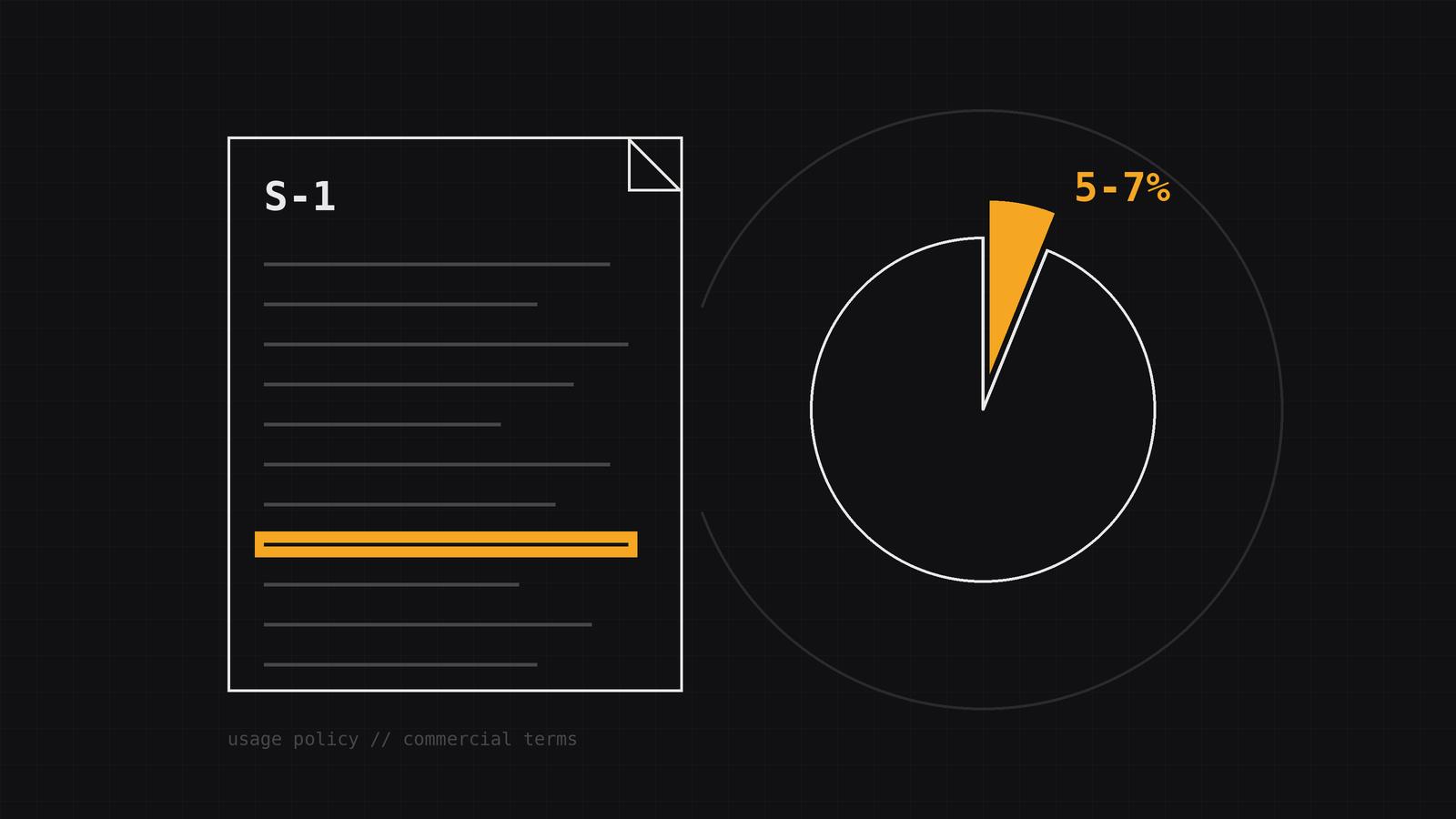
The quiet one is buried in the results section: 5% to 7% of 2026 revenue came from customers Anthropic later found were breaking the rules. And it's going to cut those customers off.
That second confession says more about the price of your tokens, about the risk of your account getting shut down, and about what happens to your API after the IPO than any bubble debate. In this post we read the filing the way a dev should: separating what's actually written in the S-1 from press coverage and from rumor.
TL;DR
- What it is: Anthropic's S-1, the public IPO prospectus filed with the SEC on 10/26/2026 (filing on the SEC site).
- Confession 1 (verified in the S-1): $16.3B in revenue in H1 2026, up from $1.16B a year earlier, and a pre-tax loss of $80.7B, of which $72.4B is a fair-value markup on convertibles.
- Confession 2 (verified in the S-1): 5% to 7% of revenue for the nine months ended 9/30 came from customers violating the usage policy or commercial terms. That revenue isn't expected to recur.
- Rumor/reported: a $1.5T to $2T valuation and a Thanksgiving-week debut. The "ANT" ticker on Nasdaq is already in the filing.
- If you run Claude in production: tougher enforcement is coming. If your architecture depends on a gray zone, it sits inside the slice of revenue Anthropic has already said it will cut.
What Anthropic's S-1 confesses (exact wording)
Before the analysis, the text. Because over the next 48 hours you'll read a lot of wrong paraphrasing.
In the risk factors, Anthropic writes that its revenue "has also included, and we expect will continue to include, amounts from customers that we subsequently determine are using our models, platform, and applications in violation of our usage policy or commercial terms, and whose revenue would not be expected to recur following restriction or termination of their access" (S-1).
In the results section, it puts a number on it:
"Based on our detection and review process, we estimate that revenue from
such customers represented approximately 5% to 7% of our revenue for the
nine months ended September 30, 2026."
And it adds three details that matter a lot more than they seem to:
- "We believe this dynamic is common in our industry." Anthropic is saying OpenAI, Google and the rest have the same problem. It's just the first one forced to quantify it, because an IPO requires it.
- Enforcement stepped up "in particular in August and September 2026", with the expectation that the percentage will decline in future periods. Translation: the cutting has already started.
- "Customers may evade our controls (...) and may re-register under new accounts." It admits this is cat and mouse. A banned customer comes back with a new account.
The estimate, the filing itself says, "requires judgment and may change" as detection evolves. In other words: 5% to 7% is what they've found so far, not the ceiling.
RuntimeWire was first to pull this passage, and Fortune repeated the number. I checked the SEC text: it's there, in both sections.
Who is this rule-breaking customer? The Moonshot case
"Usage policy violation" sounds abstract until you remember the case we covered earlier this month.
Anthropic accused Moonshot of relaying Kimi customer requests to Claude and returning the answers as if they came from Kimi itself. Nearly 300,000 requests in ten days, thousands of fraudulent accounts on a proxy network, and a pipeline built to extract the model's reasoning. Moonshot denies it and says it will go to court. The report relies on Anthropic's own logs.
Now put the pieces together. Every one of those requests was paid for. It was revenue. It counted until Anthropic detected it, investigated it and took the accounts down. That's exactly the kind of revenue the S-1 describes: real this quarter, gone the next.
And it's not just a Chinese lab distilling a model. The same bucket includes unauthorized access resale, account sharing at scale, using outputs to train a competing model, and anything else the usage policy forbids. Some of it is people you know. Sometimes it's the "cheap Claude proxy" someone shared in the group chat.
This is the kind of reading that separates people who consume headlines from people who build products on top of a model vendor. If you want to talk this through with people who actually run AI in production, with harnesses, agents, RAG and evals, that's the weekly conversation at the Clã Beer and Code.
The $80 billion loss: it's almost all accounting
Now the loud confession. Here are the income statement numbers from the S-1, in millions of dollars:
| Line | H1 2025 | H1 2026 |
|---|---|---|
| Revenue | 1,163 | 16,286 |
| Compute and infrastructure | 2,334 | 8,945 |
| Operating loss | (2,135) | (693) |
| Change in fair value of convertible notes, derivatives and SAFEs | (10,942) | (72,388) |
| Other expense, net | 0 | (8,757) |
| Loss before income taxes | (12,962) | (80,727) |
Source: Anthropic's S-1 on the SEC site.
Read the table slowly.
Revenue grew 14x in a year. The operating loss, which is what the company loses actually running the business, dropped from $2.1B to $693 million. And of the $80.7B loss, $72.4B is an accounting markup: when the company becomes worth a lot more, the convertible notes and SAFEs it issued earlier become worth more too, and that difference is booked as an expense. It's not cash leaving the building.
Fortune also reports positive operating cash flow of $3.9B for the half and a 19% adjusted operating margin in Q2.
So here's the paradox: the more the market believes in Anthropic, the bigger the "loss" on paper. Anyone using the $80B as proof of a bubble is reading the wrong line.
The right line is compute. $8.9B in six months, more than the $7.3B for all of 2025. And the WSJ, via Investing.com, reports roughly $450B in noncancelable cloud contracts over the next decade. That's the cost someone is going to have to pay. Per token.
Customer concentration: the number changed between the draft and the S-1
Careful here, because the coverage doesn't line up.
The WSJ, based on a preliminary version of the prospectus, reported that about 20% of first-half revenue came from two customers.
The public S-1 says something different: no single customer exceeded 10% of revenue in the nine months ended 9/30, and about 79% of Q3 revenue came from outside the top five customers, up from 64% in Q1.
It's not necessarily a contradiction. They're different cuts (two customers over the half vs. top five in a quarter). But the trend the official filing shows is dilution: the base is getting more spread out, while the big accounts keep growing.
Do not just follow the news — master it. Hands-on AI Engineering, live, every week, in the largest community in Brazil.
Join the ClãThe bubble chorus: who's saying what
The S-1 lands at the worst possible moment for market sentiment. In three weeks:
- Ray Dalio (10/7): called AI a "classic bubble" close to its bursting point, driven by debt and rising rates.
- IMF (10/13): in its financial stability report, warned that the boom "could quickly turn to bust if the promised profits fail to materialize", and pointed to circular financing: AI companies acting as each other's investors, lenders and customers.
- CoreWeave (10/14): its 2032 bonds fell below 80 cents on the dollar, with yields near 15%. Nebius fell with it the same day.
- Ken Griffin (10/20): the Citadel founder said we're "almost certainly" in a bubble, but didn't tell anyone to sell. He compared GPUs to airline seats: if supply outruns demand, prices collapse.
- China (10/26): Reuters published the analysis "In China, the AI bubble has already burst" today. The STAR50, an AI and semiconductor index, fell about 40% in under four months.
What does an AI bubble actually mean?
A bubble isn't "the technology doesn't work." It's asset prices disconnected from the cash flow those assets will generate. The internet worked. Pets.com went bust anyway.
Griffin himself makes that distinction: bubbles come with big economic shifts, and the survivors lead for decades. The useful question for a dev isn't "is it a bubble?" It's "is the vendor I depend on on the survivors' side, and what will it do to pricing to make sure it stays there?"
And this is where Anthropic's S-1 sends a deliberately mixed signal. Operations improving, cash flow positive, revenue diluting. But also a slice of revenue the company itself labels as disposable, and a compute bill that only grows.
What this changes for your token price
Here's the reasoning I don't think the headlines will get to.
A private company can tolerate questionable revenue. A public one can't. After the IPO, every quarter becomes a report analysts tear apart, and "we grew, but 6% of that was fraud we're going to cut" is exactly the kind of sentence that tanks a stock.
So Anthropic has two incentives that move together:
1. Cut the bad revenue faster. That means more detection, more verification, more bans. We already saw the start of it with identity verification on Claude. Aggressive detection has false positives. If your account has an odd usage pattern (lots of keys, proxy traffic, volume that looks like resale), you'll trip the filter even if you're within the rules.
2. Replace that 5% to 7% with good revenue. In a market that's already skeptical. That pushes toward enterprise, annual contracts, plans with volume commitments. And it leaves less room for aggressive retail pricing.
I'm not saying per-token prices go up tomorrow. The track record shows per-token prices falling hard, as we broke down in Will AI get more expensive?. I'm saying the implicit discount goes away: generous limits, plans that let you overuse, tolerance for borderline usage. That's what tightens first. And we called this move back when the Anthropic IPO was still just investor meetings.
Checklist for running Claude in production
None of this calls for panic. It calls for engineering.
- [ ] Actually read the usage policy and the commercial terms. Access resale, a wrapper that exposes the raw API to third parties, using outputs to train a competing model: confirm your case is inside the lines.
- [ ] One account, one owner, one purpose. Keys spread across ten accounts to "dodge the rate limit" is exactly the pattern a fraud detector looks for.
- [ ] Treat a 403 as an incident, not a bug. A restricted account takes down your whole product. Have alerts and a runbook.
- [ ] Keep a provider fallback ready and tested. It doesn't need to be automatic for everything, but it needs to exist.
- [ ] Don't buy "cheap Claude" from a third party. If the price is too good to be true, you're probably paying for the revenue the S-1 says is going away. And it'll go away along with your access.
A minimal example of the third and fourth items, in Python, with the official SDK:
import anthropic

client = anthropic.Anthropic()

def gerar(prompt: str) -> str:
    try:
        resp = client.messages.create(
            model="claude-sonnet-5-5",
            max_tokens=1024,
            messages=[{"role": "user", "content": prompt}],
        )
        return resp.content[0].text
    except anthropic.PermissionDeniedError as e:
        # 403: restricted account or key. Not a retry, an incident.
        alertar_oncall("anthropic_403", detalhe=str(e))
        return gerar_com_fallback(prompt)
    except anthropic.AuthenticationError as e:
        # 401: revoked or invalid key.
        alertar_oncall("anthropic_401", detalhe=str(e))
        return gerar_com_fallback(prompt)
The point isn't the code. It's the architecture decision: your product can't depend on a single account with a single vendor that just announced, in writing, that it's tightening enforcement.
Limits of this reading
- 5% to 7% is Anthropic's own estimate, based on "judgment", and the filing warns it may change. There's no independent audit of that number.
- The S-1 doesn't fill in Q3 revenue. The field is blank in the filing. Any Q3 number you read today is coverage, not the S-1.
- The $1.5T to $2T valuation and the Thanksgiving-week date are reported by Fortune, not set in the prospectus. The per-share price range is still blank.
- The Moonshot case is an accusation, based on Anthropic's logs, and Moonshot denies it.
- This post is not investment advice.
FAQ
What is Anthropic's S-1?
It's the registration statement a company files with the SEC, the US market regulator, before going public. It includes audited financial statements, risk factors and the governance structure. Anthropic's runs over 300 pages, about 94 of them just risk factors, according to Fortune.
Is Anthropic losing money?
On paper, yes: an $80.7B pre-tax loss in the first half of 2026. But $72.4B of that is a change in the fair value of convertibles and SAFEs, a non-cash accounting expense. The operating loss was $693 million, well below the $2.1B in the same period of 2025.
When is the Anthropic IPO and what's the ticker?
The S-1 confirms the application to list on the Nasdaq Global Select Market under the ticker "ANT". The date isn't in the filing: the press reports a debut targeting Thanksgiving week, in late November 2026.
Can you buy Anthropic stock from Brazil?
Not before the IPO. After the listing, the natural route is a broker with access to the US market. A local BDR depends on some institution issuing one, and that doesn't exist yet. Again: not a recommendation.
What does an AI bubble mean?
It's when the price of AI-related assets rises well above what future profits justify. It doesn't mean the technology is useless. It means some companies and investors will lose money until prices come back to reality.
Does this affect people using the Claude API?
Indirectly, yes. The trend is stricter usage policy enforcement, more account verification and less tolerance for gray-zone usage. People within the rules may hit false positives. People outside them should expect to be cut off.
Conclusion
The $80B loss will dominate the conversation. It's the wrong confession to pay attention to.
The one that matters is the 5% to 7%. It says part of the fastest growth in software history was revenue that shouldn't have existed. It says Anthropic knows it, measured it, and is going to cut it. And it says the rest of the industry has the same problem, it just hasn't had to disclose it yet.
For anyone building products on top of a model, the lesson isn't about bubbles. It's about vendors.
Your AI vendor is about to become a public company, with analysts scrutinizing revenue quality every quarter.
Architect like that matters. Because it does.

{AI Engineer} — apaixonado por Laravel, arquitetura de software e construir produtos com impacto. Compartilho aqui tutoriais, descobertas e reflexões sobre o dia a dia de engenharia.
There is no shortage of content. What is missing is someone to untangle it: what matters now is how to implement it the right way. In the Clã you get that live, every week, with people who have already filtered out the noise.
Join the Clã