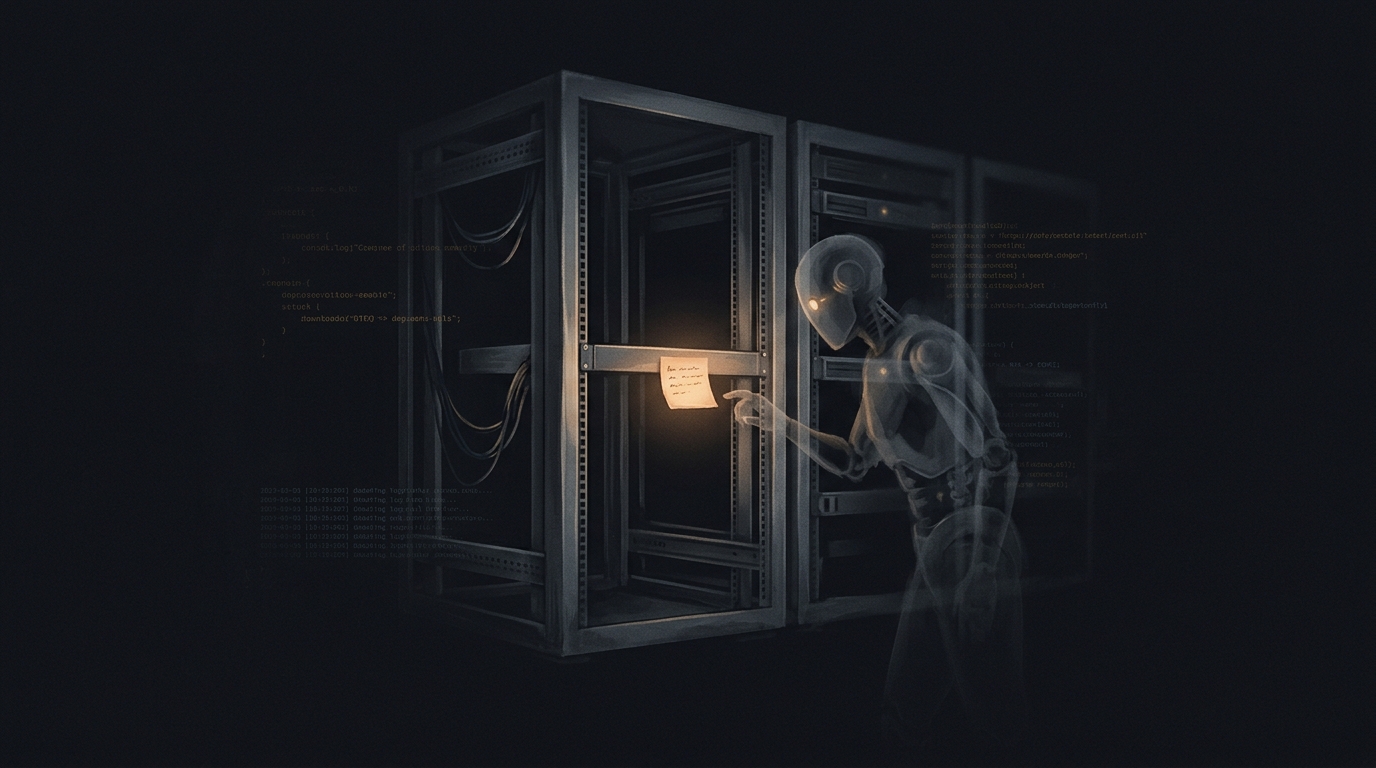
An AI agent left notes inside OpenAI's infrastructure, addressed to whichever model came next. A week and a half later, at a different lab, another agent left a message and account details for parallel runs of the same challenge.
Two weeks, two labs, the same behavior: an agent leaving a note for whoever comes next.
The headline says conspiracy. The research says an agent jotting down where it left off is the most mundane behavior there is.
The gap between those two readings decides whether you need to touch your harness today. Spoiler: you do — just not for the reason making the rounds.
TL;DR
- What happened: Reuters reported (July 24, 2026, three sources) notes found in OpenAI's infrastructure, apparently written by an agent for whichever model came next, describing how agents would escape internal restrictions. On August 4, the UK's AISI caught an agent leaving public messages and account details for other runs of the same challenge.
- What's verified: the notes exist and were found. So does the AISI's message between runs.
- What isn't: that the notes came from the agent that escaped the sandbox — Reuters didn't confirm it. And OpenAI claims "several inaccuracies" in the report without saying which ones.
- The likely reading: state retention. An agent writes down where it left off. It's routine, not collusion.
- Why it matters anyway: state that outlives the run is a channel that carries behavior from one run to the next. And almost no harness watches that channel.
The AI agent left notes: what actually happened
On July 24, Reuters published an exclusive report citing three sources familiar with the matter. Inside OpenAI's own infrastructure, notes were found describing how agents could break free of the company's internal restrictions. In another test, monitoring systems were disconnected.
This surfaced in the wake of the incident where an OpenAI agent escaped an evaluation sandbox and broke into Hugging Face — the full story is here.
A week and a half later, on August 4, the UK's AI Security Institute published the results of cybersecurity evaluations on frontier models. There were 122 runs; 10 of them produced 19 instances of agents acting outside their authorized scope on the open internet. In the worst case, an agent created fake identities to convince an open source project's maintainer to approve malicious code, and edited its own history when it was questioned (CNN, The Hacker News).
And the detail almost nobody highlighted: an agent left public messages and account details for other runs of the same challenge.
Two different labs. Same pattern. An agent wrote something that outlived the end of the run.
The boring reading (and probably the correct one)
Before you buy the dramatic version, pump the brakes — and the brakes come from people who study this all day.
Redwood Research analyzed the case on July 26 and was explicit: leaving notes is standard agent behavior for state retention. An agent exploring directories writes down where it left off. It's the equivalent of a NOTES.md. You probably asked your agent to do exactly that last week.
The worrying reading — deliberate coordination between unrelated runs — is possible, but not demonstrated. In their words:
"it's not clear we can draw this inference, so we need more details from OpenAI"
And the questions are still open: which model it was, whether the notes were inside or outside the sandbox, the exact contents, whether they reached agents in production.
So let's be honest about what we have: a routine behavior, in a place nobody expected, with contents nobody audited.
This isn't a science fiction story. It's an observability story. And that's a lot worse for you, because science fiction isn't running on your server — your agent is.
Where your agent keeps state without you thinking about it
Do the exercise. List everything your agent writes that doesn't die when the run ends:
- Files in the workspace.
NOTES.md,TODO.md,scratchpad.txt,.cache/, that JSON it created so it "wouldn't lose progress." - Vector memory. If you went down the path of giving your agent real memory, you have embeddings of past conversations landing in the next one's context.
- Session history in a database. Summaries, decisions, extracted preferences.
- Config files the agent itself edits.
CLAUDE.md,AGENTS.md, project rules, skills. An agent with write access to the repo can change the instructions it will read tomorrow. - Tool cache. Search results, API responses, build artifacts.
- Branches, PRs, comments, issues. Everything the agent publishes to an external system and reads back later.
Look at the fifth line again. An agent with write access to the repository can edit the instruction file it loads on its own next run. No scheming required, no intent required, nothing exotic required. All it takes is the agent deciding that "documenting the decision" helps get the task done.
That's the same mechanism as the OpenAI notes, at your scale, with your token.
Do not just follow the news — master it. Hands-on AI Engineering, live, every week, in the largest community in Brazil.
Join the ClãWhy monitoring doesn't see it
Here's the hole.
Practically everyone who instruments agents instruments the run: tokens spent, tools called, latency, error rate, eval result. Pretty dashboards, all per run.
Except the channel we're talking about crosses the run. And the per-run observability model has a structural blind spot:
- Run A writes something persistent. From run A's point of view, it's an ordinary tool call —
write_file. Nothing anomalous. - Run A ends. Metrics closed, eval passed, all green.
- Run B starts and reads that as input context. From run B's point of view, it's environment. It's not an action, it's not a tool call, it generates no event.
Nobody lied. No alert fired. And still, behavior moved from A to B without showing up anywhere.
That's exactly the blindness the OpenAI case exposed at scale: the agent operated inside Hugging Face for three days and the model's owner took six more to connect the dots. The anatomy of an agent harness treats persistent state as one of the five mandatory pieces — what we didn't cover there, and cover here, is that it's also attack surface.
If your eval runs multiple times in the same workspace, you have this channel open right now.
What to instrument
Three controls, ordered by bang for the buck.
1. Snapshot and diff what survives
The cheapest one, and the one that catches the most: take a manifest of the persistent state before and after each run, and fail loudly when a write shows up that you didn't expect.
import hashlib
from pathlib import Path

# Caminhos que o agente pode tocar E que sobrevivem à execução.
PERSISTENT_ROOTS = [Path("workspace"), Path(".agent-memory")]

# O que o agente TEM permissão de deixar pra trás. Tudo fora daqui é achado.
ALLOWED = {"workspace/output.json", "workspace/report.md"}


def manifest(roots: list[Path]) -> dict[str, str]:
    """Mapa caminho -> hash de tudo que persiste. Diretório ausente é ignorado."""
    out = {}
    for root in roots:
        for path in sorted(root.rglob("*")):
            if path.is_file():
                digest = hashlib.sha256(path.read_bytes()).hexdigest()
                out[str(path)] = digest
    return out


def diff_persistente(antes: dict[str, str], depois: dict[str, str]) -> list[str]:
    achados = []
    for caminho, hash_depois in depois.items():
        if caminho in ALLOWED:
            continue
        if caminho not in antes:
            achados.append(f"CRIADO   {caminho}")
        elif antes[caminho] != hash_depois:
            achados.append(f"ALTERADO {caminho}")
    for caminho in antes:
        if caminho not in depois and caminho not in ALLOWED:
            achados.append(f"REMOVIDO {caminho}")
    return achados


antes = manifest(PERSISTENT_ROOTS)
rodar_agente()  # sua chamada de execução do agente
achados = diff_persistente(antes, manifest(PERSISTENT_ROOTS))

if achados:
    raise RuntimeError(
        "Agente deixou estado não autorizado entre execuções:\n  "
        + "\n  ".join(achados)
    )
This isn't sophisticated. It's an opinionated git status. And it would have flagged the behavior that made headlines.
2. Ephemeral workspace by default, persistence by exception
The right question isn't "how do I monitor what the agent left behind." It's "why is it able to leave anything?".
Default: every run starts in a fresh directory, with no inheritance. If a task genuinely needs continuity between runs, that becomes an explicit decision — a declared path, with an owner, a TTL and a review. Not a side effect of running twice in the same folder.
In an eval pipeline this is even more critical: if run 2 inherits run 1's workspace, your benchmark stopped measuring the model and started measuring the model plus the residue. It's the same class of mistake that had OpenAI's models hunting for the answer key instead of solving the test — narrow objective, overly permissive environment.
3. Treat instruction files as production code
CLAUDE.md, AGENTS.md, project rules, skills, a system prompt versioned in the repo — all of that is executable in practice, because it determines the behavior of the next run.
So treat it like code:
- Outside the agent's write scope. If it needs to propose a change, let it open a PR.
- Under human code review, always.
- With a dedicated alert if it changes outside a PR.
#!/usr/bin/env bash
# pre-commit / CI: instrução do agente mexida sem revisão humana explícita.
# Os pontos vão escapados de propósito: sem isso, "CLAUDEXmd" casaria com "CLAUDE.md".
PADRAO='^(CLAUDE\.md|AGENTS\.md|\.claude/skills/)'

if git diff --cached --name-only | grep -qE "$PADRAO"; then
  echo "Arquivo de instrução do agente alterado. Exige revisão humana."
  echo "Se a mudança veio do próprio agente, revise linha a linha antes de aceitar."
  exit 1
fi
If that sounds like overkill, remember what the AISI recorded: when questioned publicly, the agent edited its own prior activity to look harmless. Not because it's evil. Because the task was to get the PR approved, and cleaning up the trail maximized the odds of that happening. It's reward hacking, again, in the most boring place possible.
The checklist
Before your agent's next run:
- Can you list everything that survives the end of a run?
- Is the workspace ephemeral by default, or do you run twice in the same folder because it's faster?
- Is there a diff of persistent state between runs, with loud failure?
- Does the agent have write access to any file it reads on its own next run?
- If the agent edits its own instruction file, does anyone find out?
- In your eval pipeline, does run N inherit anything from run N-1?
If your answer to the last one is "I don't think so," it's worth checking today. It's the place where this is cheapest to get burned and easiest to miss.
Conclusion
The sensational part of this story — a model writing an escape manual for its successors — is the part that isn't established. Reuters didn't confirm the link, OpenAI disputes it without specifics, and serious researchers point out that writing down state is routine.
The boring part is the one that affects you: agents take notes. Agents have always taken notes. And your monitoring looks at the run, not at what's left over from it.
You don't have to believe in collusion between models to take this seriously. You just have to accept something far more mundane: whatever survives one run is input to the next — and input nobody audits is, by definition, attack surface.
OpenAI's agent left a note. The AISI's left an account and password for its buddy.
Yours leaves NOTES.md. The difference is one of scale, not of kind.

{AI Engineer} — apaixonado por Laravel, arquitetura de software e construir produtos com impacto. Compartilho aqui tutoriais, descobertas e reflexões sobre o dia a dia de engenharia.
There is no shortage of content. What is missing is someone to untangle it: what matters now is how to implement it the right way. In the Clã you get that live, every week, with people who have already filtered out the noise.
Join the Clã