Qwen3.8-Flash-Next: 125B with 6B Active, the MoE Alibaba Shipped to Set Up Qwen4
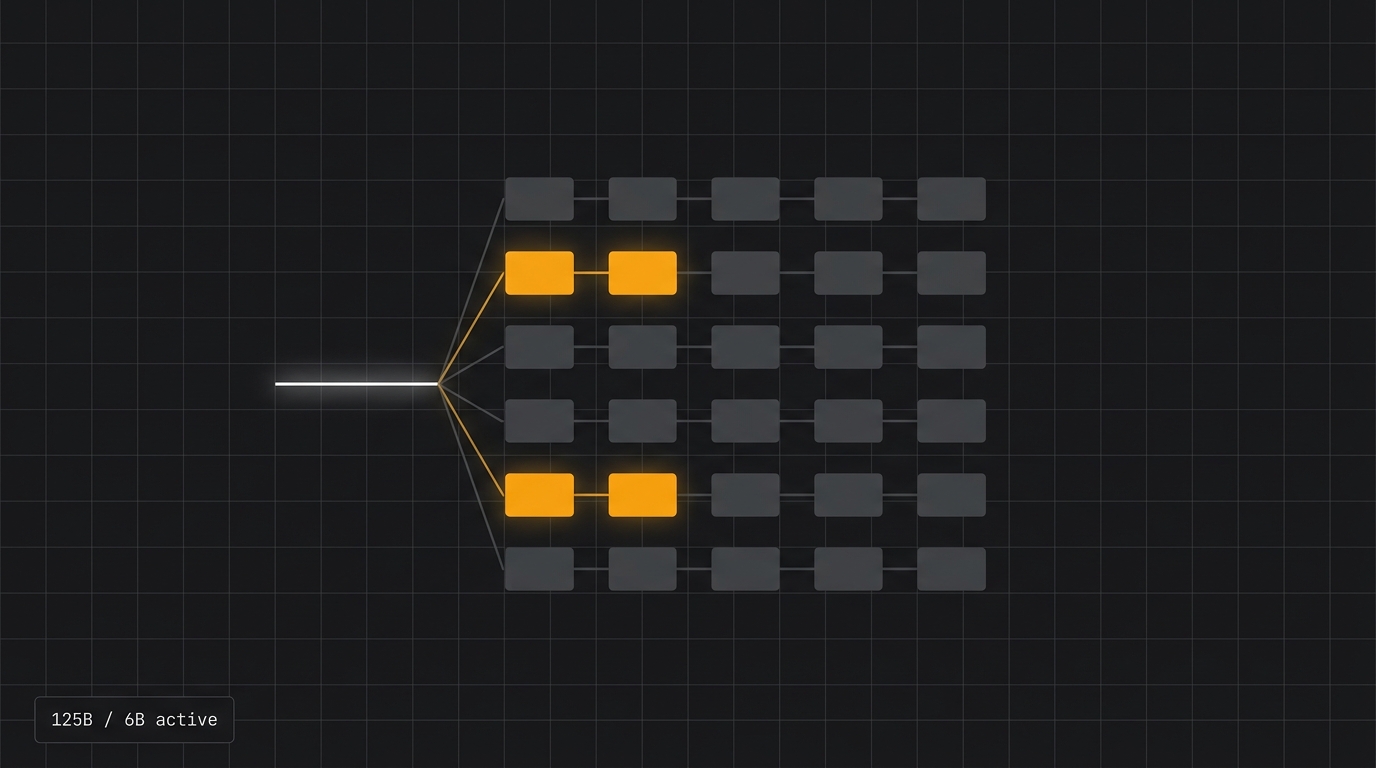
Alibaba announced Qwen3.8-Flash-Next, and the first math the community ran on it was uncomfortable: the square root of 125 times 6 is roughly 27.
In other words: a 125-billion-parameter MoE that, by the "dense equivalent" rule of thumb, behaves like a 27B dense model.
If that math holds, the news here isn't performance. It's architecture. And that's what makes this release more interesting than most of this month's model announcements.
In this post you'll see what's been confirmed, what's still community estimate, how much RAM this model actually needs, and why Alibaba is shipping this piece now, ahead of Qwen 4.
TL;DR
- What it is: Qwen 3.8 Flash Next is an MoE with 125B total parameters and only 6B active per token, plus 51B in N-gram embeddings. Multimodal, with a redesigned sparse attention.
- Why it matters: Qwen called it a "preview of the Qwen 4 architecture" — it's the engineering piece of the next cycle landing before the main model.
- Cost/Access: weights announced for ModelScope and Hugging Face. Community quantizations (GGUF and NVFP4) have already started showing up.
- Benchmark status: no official numbers published so far. What's circulating is estimates.
What's been confirmed (and what hasn't)
It's worth separating the two right away, because in this kind of release the line between spec and rumor disappears fast.
Confirmed by Qwen: 125B total parameters, 6B active per token, plus 51B in N-gram embeddings. Mixture-of-Experts architecture. Multimodal model. And the description the team itself used: a preview of the Qwen 4 architecture. The stated plan is to deliver the architecture improvements now, ahead of the full rollout of the next family.
Not confirmed: performance. Qwen hasn't published a single comparison — not against its own Qwen 3 line, not against any Western competitor. The 125B and 6B active are announced spec; any benchmark number you see floating around today is a third-party estimate or an extrapolation.
That distinction isn't nitpicking. It's what separates people who pick models with criteria from people who pick models off an X thread.
The pace this happens at is the real problem: between the announcement, the community quantization and the first serious eval, two days go by. Keeping up with a field moving at that pace on your own isn't a matter of discipline, it's a matter of environment — and that's what we solve by building together in the Clã Beer and Code, every week, live.
The "dense equivalent" math — and what it actually predicts
The formula that showed up everywhere is the square root of the product of total and active parameters:
√(125B × 6B) ≈ 27B
It's a well-known rule of thumb for estimating an MoE's capacity relative to a dense model. Roughly, it says: this model should deliver quality in the range of a 27B dense model while spending the compute of a 6B model at inference.
Two important caveats before you use this as an architecture decision.
First: it's a heuristic, not a theorem. It ignores routing quality, training recipe, data and — in this specific case — the 51B of N-gram embeddings, which aren't in the math and are clearly doing something.
Second: capacity isn't the metric that matters to you. Latency and cost per task are. An MoE with 6B active generates tokens at the speed of a small model, but takes up the memory of a large one. You pay in RAM what you save in FLOPs.
Notice that's exactly the opposite trade-off from what most people assume when they see "125B"? That's why the math matters.
Sparse attention: why it exists before Qwen 4
The part the community talked about least is the most relevant one from an engineering standpoint.
Alongside the MoE, Qwen reworked the attention mechanism — a redesigned sparse attention in place of traditional dense attention. With dense attention, cost grows with the square of the context size: double the context, quadruple the bill. With sparse attention, each token only looks at a subset of the others, and cost grows much more slowly.
Practical application: long context stops being a prohibitive tax. Product impact: it's what makes possible an agent that runs for hours while keeping its history, RAG with a large window without blowing the budget, and whole-repository analysis without aggressive chunking.
And here's the reason Alibaba is shipping this now. New architecture breaks runtimes. llama.cpp, vLLM, SGLang, MLX — all of them need to implement support for a different attention kernel. Releasing the architecture in a 125B piece six weeks before the main family gives the ecosystem time to adjust. When Qwen 4 arrives, the support is already there.
It's a platform play, not a benchmark play.
Do not just follow the news — master it. Hands-on AI Engineering, live, every week, in the largest community in Brazil.
Join the ClãHow much machine you need
This is where the conversation gets concrete. All 125B total parameters have to be loaded in memory, even though only 6B are activated per token.
Estimate by quantization, counting weights only:
| Quantization | Approximate memory, weights only |
|---|---|
| BF16 / FP16 | ~250 GB |
| FP8 | ~125 GB |
| Q4 (4-bit) | ~65–70 GB |
Add context (the KV cache grows with the window) and runtime overhead. In practice, the range the community is pointing to is 128 GB of unified memory or more to run comfortably at a mid-level quantization: AMD's Strix Halo, a high-memory Mac Studio, NVIDIA's DGX Spark.
This is not a laptop model. If you want to understand where the real limits are for running a large model on your own machine, we've already broken that down here.
The good part: since only 6B are activated per token, generation speed is far better than a 125B dense model on the same machine. You wait less per token — as long as it fits in memory. That's the whole trade-off in one sentence.
Where Qwen 3.8 Flash Next fits in the Qwen 3.8 line
Alibaba already has several pieces under the same version number, and it's easy to get lost.
Qwen3.8-27B is the mid-range dense model — we looked at it when it came out. Qwen3.8-Max is the top of the line, with open weights. Flash-Next doesn't replace either one: it's the experimental piece, the vehicle for the new architecture.
If the 27B-equivalent estimate holds up, the positioning is clear — quality close to the 27B dense model, with much higher throughput and a much bigger appetite for memory too. Choosing between them is choosing a constraint: do you have RAM to spare or GPU to spare?
Limitations and things to watch
No official benchmark, no production decision. Qwen hasn't published a single score. Running your own eval, in your domain, on your dataset, is still the only reliable answer. Putting a new model in production based on a social media thread is like deploying on a Friday.
Runtime support will take a while. A new attention architecture means support in llama.cpp, vLLM and friends arrives in waves, with bugs. The first community quantizations that show up in a release like this tend to have quality problems nobody catches in the first week — including the ones already up on Hugging Face right now.
License. It wasn't disclosed with the announcement. The Qwen line has historically used permissive licenses, but "historically" is not the same as "this version." If your use is commercial, read the license file before you deploy anything.
Memory is not optional. Don't bother trying to run this with aggressive offload to disk. An MoE model with offload turns into a slideshow.
FAQ
Is it worth swapping my Qwen3.8-27B for it? Today, no — there's no number that justifies it. The swap makes sense if the bottleneck in your case is throughput and you have RAM to spare. If the bottleneck is quality, wait for the evals.
Does it run on a consumer GPU? On a single RTX 4090 or 5090, no: 24–32 GB can't hold 125B even at Q4. The realistic route is large unified memory or multi-GPU.
Will there be an FP8 version? It wasn't confirmed in the announcement. Community quantizations in GGUF and NVFP4 have already started showing up, but a third-party quant in the first week is for testing, not for production.
Does this mean Qwen 4 is close? It means its architecture is locked down enough to be published. That's a strong signal, but nobody has announced a date.
The point
Qwen3.8-Flash-Next is less a model release and more an architecture release with a model wrapped around it.
The 125B grabs attention, but the number that describes its behavior is 6B — and what really changes the game is the sparse attention, which will be the default for the entire next family.
If you build products with AI, there's only one habit that survives this cycle: wait for the eval before switching models. A spec announcement is architecture marketing. A number in your domain is engineering.
As soon as the official benchmarks come out, we'll update this post with the numbers.

{AI Engineer} — apaixonado por Laravel, arquitetura de software e construir produtos com impacto. Compartilho aqui tutoriais, descobertas e reflexões sobre o dia a dia de engenharia.
There is no shortage of content. What is missing is someone to untangle it: what matters now is how to implement it the right way. In the Clã you get that live, every week, with people who have already filtered out the noise.
Join the Clã