From Screen to Dialogue: Natural Language Interfaces Are the Biggest Open Opportunity for Brazilian Devs
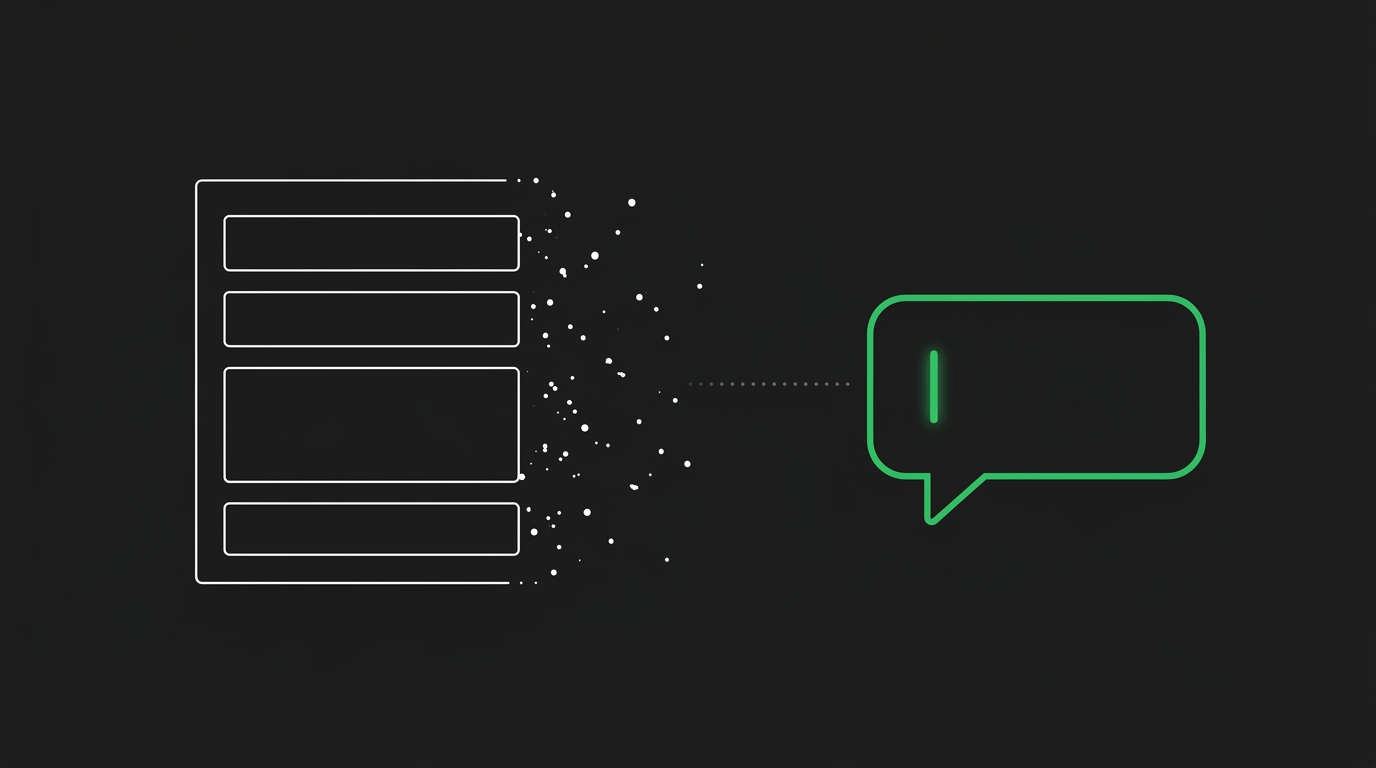
Brazilians run their lives out of a text box. Booking appointments, haggling over prices, sending payment receipts, complaining about an order. All of it on WhatsApp. And in five years they swapped boleto, wire transfers and cash for an interface that didn't exist before.
Now open the app of the company you work for. A twelve-field form. A menu with nine options. "Press 4 for a copy of your bill." The person on the other end already lives in a natural language interface. The company is still shipping screens.
That mismatch is the post. I'm going to show, with numbers and sources, why the shift from screen to dialogue is already a funded movement abroad, why Brazil is the most fertile ground in the world for it, and why the bottleneck isn't the model or the customer. It's who knows how to build the agent and get it to production.
TL;DR
- The thesis: the interaction and logic layer of applications is moving from screens (GUI, forms, dashboards) to natural language (chat, voice, agents). The screen becomes one of the possible renderers, not the product.
- The three numbers: Gartner projects 40% of enterprise applications with task-specific AI agents by the end of 2026 (up from less than 5% in 2025). WhatsApp is on 99% of Brazilian smartphones. Only 17% of Brazilian companies used any AI in 2025.
- What's in it for devs: the market has no shortage of people who can demo a chatbot. It has a shortage of people who can take an agent to production, with legacy system integration, evals and guardrails. That's the open gap.
- The caveats: 95% of enterprise generative AI pilots produced no measurable return, Gartner predicts more than 40% of agentic projects will be canceled by 2027, and not every screen becomes a chat. The thesis holds up better when it owns that.
The context: abroad, the migration is already funded
This isn't a futurist's prediction. It's money in motion.
Menlo Ventures measured enterprise spending on generative AI in the United States in 2025: it went from $11.5 billion to $37 billion in one year. The fastest category expansion in the history of enterprise software. And 76% of use cases today are bought, not built in-house. There's a growing vendor market, and it needs people who build.
Gartner put a number on the thesis in August 2025:
"Forty percent of enterprise applications will be integrated with task-specific AI agents by the end of 2026, up from less than 5% today."
In the same release, the projection that backs this post's title: by 2028, a third of user experiences will move from native apps to agentic front ends. A third. Of the interface.
On the consumer side, conversation became a mass habit. ChatGPT went from 400 million weekly users in February 2025 to 900 million in February 2026. More than doubled in twelve months.
And then there's the "SaaS is dead" debate. In December 2024, Satya Nadella said on the BG2 podcast that business applications will "collapse in the agent era," because deep down they're CRUD databases with business logic, and that logic is going to move to the AI layer. The balanced reading isn't that SaaS dies. It's that the backend becomes a commodity and the value moves up to the conversational and agentic layer. For devs, the conclusion is the same under both readings: the value is moving somewhere else.
The concrete cases confirm it, with one important catch. Klarna published in February 2024 that its AI assistant handled 2.3 million conversations in its first month, the equivalent work of 700 agents, with resolution time dropping from 11 minutes to under 2 and an estimated $40 million in additional profit. Chapter two: in May 2025 the CEO admitted to Bloomberg that the cuts went too far, and the company started hiring humans again. The migration isn't linear. Quality and trust are real bottlenecks.
Even so, capital keeps betting. Sierra, Bret Taylor's customer service agent company, raised $950 million at a $15.8 billion valuation in May 2026, with more than $150 million in recurring revenue in eight quarters.
Notice the pattern running through Klarna, Sierra and the Menlo number. What commands a premium isn't the chatbot. It's the agent that survives production: integrated with the order system, with a clear limit on what it can do, evaluated before every deploy. That path, from the architecture decision to the agent running with metrics in hand, is what we're going to walk end to end at AI Engineering Lab 3rd Edition, live, on the mornings of September 19 and 20.
Brazil: consumers ran ahead, companies stayed put
Here's the paradox. Sky-high consumer adoption, low formal enterprise adoption.
The most rigorous survey on this is TIC Empresas from Cetic.br, with a representative sample and a public methodology. The 2025 result: only 17% of Brazilian companies used any AI. In the European Union, Eurostat measured 20% in the same year.
You'll find much bigger numbers out there. KPMG talks about 86% of companies using AI. The difference is methodology: a survey of executives who volunteer to answer questions about AI overestimates adoption, every time. When someone quotes eighty-something percent, ask who answered. That spread, by the way, is a data point in itself: Brazil is experimenting a lot and productizing very little.
Where conversational infrastructure already exists, it's from the previous generation. Mobile Time's Mapa do Ecossistema Brasileiro de Bots 2025 counts more than 1 million bots created and about 150,000 in operation. Of those, 44% use generative AI, up from 36% in 2024. In other words: most Brazilian bots in production are still decision trees with "press 1 for." The channel is installed. The brain isn't.
| Dimension | Abroad / Global | Brazil | Source |
|---|---|---|---|
| Companies using AI | 20% in the EU (2025) | 17% (2025) | Eurostat; Cetic.br |
| Enterprise apps with agents | 40% projected by end of 2026 | Most bots on flows/FAQ; 44% of active ones with GenAI | Gartner; Mobile Time |
| Enterprise spending on GenAI | $37B in 2025 (US, 3.2x in 1 year) | High experimentation, low productization | Menlo Ventures; Cetic.br |
| Venture capital | AI dominated the largest global rounds of 2025 | Only 2 of the 11 largest rounds were AI-first | Sling Hub/Startups.com.br |
| Mass conversational interface | ChatGPT: 900M weekly users | WhatsApp on 99% of smartphones, 97% daily use | TechCrunch; Opinion Box |
The last row is the one that matters. Brazil's lag is in building agents, not in the appetite of the people who'll use them.
Why Brazil is the best place in the world for natural language interfaces
Two facts no other market combines the same way.
WhatsApp is the country's social operating system. Opinion Box's WhatsApp in Brazil 2025 survey shows the app on 99% of smartphones, with 97% of users opening it every day. The estimated base is 147 million users, the second-largest market in the world behind India. And it's not just chatting with friends: 82% have talked to businesses through the app and 60% have bought through it. The channel for natural language interfaces in Brazil doesn't need to be installed. It's already in almost every customer's pocket, open.
Pix proved that Brazilians adopt a new interface at record speed. According to the Central Bank's Pix Management Report, there were 79.8 billion transactions and R$ 35.3 trillion in 2025, with 148 million individuals using it, the equivalent of 86% of the adult population. In five years the country dropped entrenched payment habits for an interface that didn't exist. If Brazilians did that with money, they'll do it with customer service and shopping.
Whoever has already put the two together is capturing the value. Nubank resolves 55% of tier-one questions with AI assistants, processes more than 2 million chats a month and cut chat response time by 70%. Magalu put Lu with generative AI inside WhatsApp in November 2025, with 100% of the buying journey in the chat, from recommendation to payment, on a multi-agent, multi-LLM architecture, rolled out to 1 million customers with a target of 30 million.
Nubank and Magalu aren't the exception because they have more money. They're the exception because they have people who know how to build this. And that's where you come in.
Do not just follow the news — master it. Hands-on AI Engineering, live, every week, in the largest community in Brazil.
Join the ClãWhat "building an agent" means in practice
This is where the conversation stops being about the market and becomes engineering. Because moving from screen to dialogue isn't swapping the form for a text box and piping the input to an LLM. That's a demo. Anyone can build a demo in an afternoon.
What changes when the interface becomes natural language:
Intent stops being explicit. In a form, the "copy of bill" button says what the user wants. In chat, they write "I didn't get the boleto again" and your system has to classify that, with evidence, before picking the route. Without that layer done right, the agent picks wrong and nobody can explain why. I already broke this down in intent classification with an LLM.
Business logic has to become a tool. The agent doesn't "know" the order status. It calls a tool that queries the order system. Every action the user used to take by clicking becomes a function with a contract, permissions and controlled side effects. This is 80% of the legacy integration work, and it's exactly where most projects die.
Context has to be retrieved, not loaded. Return policy, customer history, catalog. It doesn't all fit in the prompt, and even if it did, it would be expensive. RAG over the company's real data is what separates the assistant that answers from the FAQ from the one that solves the problem.
Evaluation becomes a deploy gate. On a screen, a bug shows up in testing. In an agent, the same prompt can get it right today and wrong tomorrow. Without a set of real cases and an eval suite running before every change, you don't have a product. You have hope.
Guardrails define the blast radius. An agent that can look up an order and an agent that can cancel an order are two products with different risks. Least privilege on the tool, human approval on irreversible actions, a spending cap per run.
Now combine that with two numbers from above. MIT Project NANDA found that 95% of enterprise generative AI pilots produced no measurable return. The bottleneck it points to isn't the model: it's integration, scope and governance. And Menlo showed that 76% of companies prefer to buy rather than build. Translation: the real shortage is of people who can make the five items above work in production. Not of people who write pretty prompts.
Before you go turning everything into an agent, it's worth running the 3-minute test. A good chunk of what's a form today should become a deterministic flow with an LLM only at input classification. A real agent is for ambiguous intent and multi-step tasks. Knowing the difference already puts you ahead.
The job market is already pricing this in
Brazil's tech talent deficit is chronic, and it has a number. Brasscom measured a 30.2% mismatch between demand (665,000) and supply (464,000) of ICT professionals between 2019 and 2024. That's before demand for agent engineering even existed as a category.
The Robert Half 2026 Salary Guide puts the AI engineer in the range of R$ 19.5k to R$ 27.1k a month, one of the best-paid IT roles in the country. I'm not promising a salary. I'm showing that the market is already paying for a skill few people have. What that job asks for day to day is in what the AI engineer recruiter is going to ask for.
And then there's the capital detail. Of the 11 largest Brazilian startup rounds in 2025, only 2 had AI at the core. Brazilian money still hasn't rushed into AI the way it did abroad. That can look like a lag. For builders, it's a window: less competition for talent, fewer companies with a team in place, more room for whoever shows up with a working agent.
Limitations and honest caveats
The thesis holds up better when it owns its limits. Five of them.
Most projects still fail. MIT NANDA's 95% measures financial return in a specific window, not technical failure, and the study isn't peer-reviewed. But the message is right: the problem is integration and scope, not model capability.
There will be mass cancellations. Gartner itself predicts that more than 40% of agentic AI projects will be canceled by the end of 2027, due to escalating costs, unclear business value or inadequate risk controls. A lot of what gets called an agent today is "agent washing": a chatbot with a new name.
Not every screen becomes a chat. GUI is still superior for work that's visual, data-dense, comparative and precise. Dashboards, editors, spatial manipulation. Conversation wins on ambiguous intent, language tasks, customer service and multi-step delegation. The correct thesis isn't "screens die." It's "the interaction and logic layer migrates, and the screen becomes one of the renderers."
The retreats are real. Klarna went back to hiring. OpenAI partially walked back Instant Checkout in March 2026 because of difficulty enabling transactions. Presenting only the first chapter of these cases weakens any argument in front of a technical audience.
The GDP impact is an estimate from an interested party. The figure of R$ 986.7 billion by 2030 was commissioned by OpenAI. Treat it as a scenario, not a fact.
Quick FAQ
Do I need to drop Laravel and PHP to get into this? No. The five items in the practical section (classification, tools, retrieval, evals, guardrails) are backend code. Queues, webhooks, API contracts, a database with pgvector. The stack you already know is the one that will orchestrate the agent. What changes is what you put on top of it.
My flow-based chatbot already does the job. Why switch? If it does the job, don't switch. A deterministic flow is cheaper, more predictable and easier to audit. Replace the part where users drop off: intent that doesn't fit the menu, questions that need context, tasks that need more than one system. The agent goes where the flow breaks, not in its place.
Where do I start without falling into the demo trap? With the channel the customer already uses and a small case with a clear metric. An order status agent on WhatsApp, with one tool, a suite of twenty real cases and a cost cap per conversation, teaches more than any course. The step-by-step with Evolution API is in how to build an AI agent for WhatsApp.
What if Gartner is wrong and the 40% never shows up? It'll probably be wrong on the date. Analyst forecasts are always wrong on the date. But WhatsApp on 99% of smartphones and Pix at 86% of adults aren't forecasts, they're 2025 data. The direction is set by user behavior, not by the report.
Conclusion
Brazilians have already migrated. They live in a conversational interface, adopt new interfaces at record speed and already buy through chat. Companies are still shipping forms, and only 17% of them used AI of any kind in 2025.
That gap isn't going to be closed by a better model. There are plenty of models. It's going to be closed by people who know how to take the business logic that lives in buttons and screens today, turn it into tools, give it context, measure it and put limits on it. Engineering, not prompting.
Whoever masters this first gets a surface nobody is fighting over yet. The next step in this migration is the screen becoming just one of the agent's renderers: the same logic serving chat, voice and visual interfaces generated on demand. When that arrives, the question won't be "which frontend framework." It'll be "who built the agent behind it."
If you want to understand what this work looks like day to day before deciding whether it's your path, read AI engineer: what the day-to-day looks like in 2026.

{AI Engineer} — apaixonado por Laravel, arquitetura de software e construir produtos com impacto. Compartilho aqui tutoriais, descobertas e reflexões sobre o dia a dia de engenharia.
There is no shortage of content. What is missing is someone to untangle it: what matters now is how to implement it the right way. In the Clã you get that live, every week, with people who have already filtered out the noise.
Join the Clã