GPT-5.6 Sol Took Down the Maxwell Conjecture: The Model Had the Idea, the Humans Did the Proof
Ten days. That's the gap between the fall of the Jacobian Conjecture, with help from Fable 5, and the paper that took down the Maxwell Conjecture with an idea suggested by GPT-5.6 Sol. Two conjectures in two weeks. And the same script both times: the model points the way, the human does the proof.
Before you close the tab thinking physics is broken: the Maxwell Conjecture has nothing to do with Maxwell's equations. The four equations of electromagnetism are still intact. The conjecture is something else, far more niche — a question about how many equilibrium points the electrostatic potential generated by n point charges can have. Maxwell speculated a ceiling in 1873. On July 29, 2026, a four-page paper on arXiv showed the ceiling is wrong.
Here we break down what the paper shows, what exactly GPT-5.6 Sol did (and what the mathematicians did), and the caveat the "150-year-old problem" headlines are leaving out.
TL;DR
- What fell: the Maxwell Conjecture, which says the field generated by n point charges has at most (n−1)² non-degenerate equilibrium points. For 5 charges, the ceiling would be 16. Don't confuse it with Maxwell's equations — different subject.
- How it fell: the paper The Maxwell Conjecture is False (arXiv 2607.27197, July 29, 2026), by Philip Arathoon, Gavin Ball and Matthew Kvalheim, exhibits a configuration of 5 charges with at least 24 non-degenerate equilibrium points.
- The AI's role: according to the authors, the idea for the construction was suggested by GPT-5.6 Sol. They verified the details, wrote the argument in their own words and checked the math in Mathematica and Maple.
- The caveat: despite the name, the conjecture was only formalized in 2007, by Gabrielov, Novikov and Shapiro. "150-year-old problem" is a headline, not history.
What GPT-5.6 Sol did (and what the mathematicians did)
The paper is short and the division of labor is spelled out in it. The authors say the idea behind the construction of the counterexample was suggested by GPT-5.6 Sol — the top model in the GPT-5.6 family, the same one that runs in Codex. From there on, the work was human: verify every mathematical detail, rewrite the argument in their own words and validate the math in computer algebra software — Mathematica and Maple, which also generated the figures.
Arathoon himself summed it up on X: "counterexample found by AI (GPT-5.6 Sol), communicated by human mathematicians". Notice the word choice. It's not "proved by AI." The suggestion came from the model; the math that holds the result up went through three people who knew exactly what they were checking.
That flow — the model proposes, the human verifies, rewrites and signs — matters well beyond math. Ideas got cheap and abundant; what creates value is the judgment of whoever validates them. Vibe coding is a technique: you accept the suggestion and hope. AI engineering is a profession: you turn a model's suggestion into something that survives scrutiny. Training that judgment, with a real project and live execution every week, is what we do at Clã Beer and Code.
The Maxwell Conjecture is not Maxwell's equations
James Clerk Maxwell, in the Treatise on Electricity and Magnetism (1873), made a passing remark: scatter n point charges in space and look at the electrostatic potential they generate. There are points where the field vanishes — equilibrium points, where a test charge would sit still. Maxwell claimed, without proof, that there would be at most (n−1)² of these points.
For two charges, at most 1 equilibrium point. For five, at most 16.
The detail the headlines cut: Maxwell left this as a comment, not as a formal problem. The ones who turned the remark into an actual conjecture were the trio Anatoly Gabrielov, Dmitri Novikov and Boris Shapiro, in the 2007 paper "Mystery of Point Charges". They wrote the precise statement — with the hypothesis that the points be non-degenerate — and proved the first rigorous ceiling in the history of the problem: a gigantic number, but finite. Until 2007, not even that existed.
In other words: the root of the problem dates to 1873, but as a precise mathematical statement it's 19 years old, not 150. Hold on to that distinction, because it comes back in a minute.
Do not just follow the news — master it. Hands-on AI Engineering, live, every week, in the largest community in Brazil.
Join the ClãThe counterexample: five charges, 24 equilibria
The construction fits in one paragraph — and it's elegant.
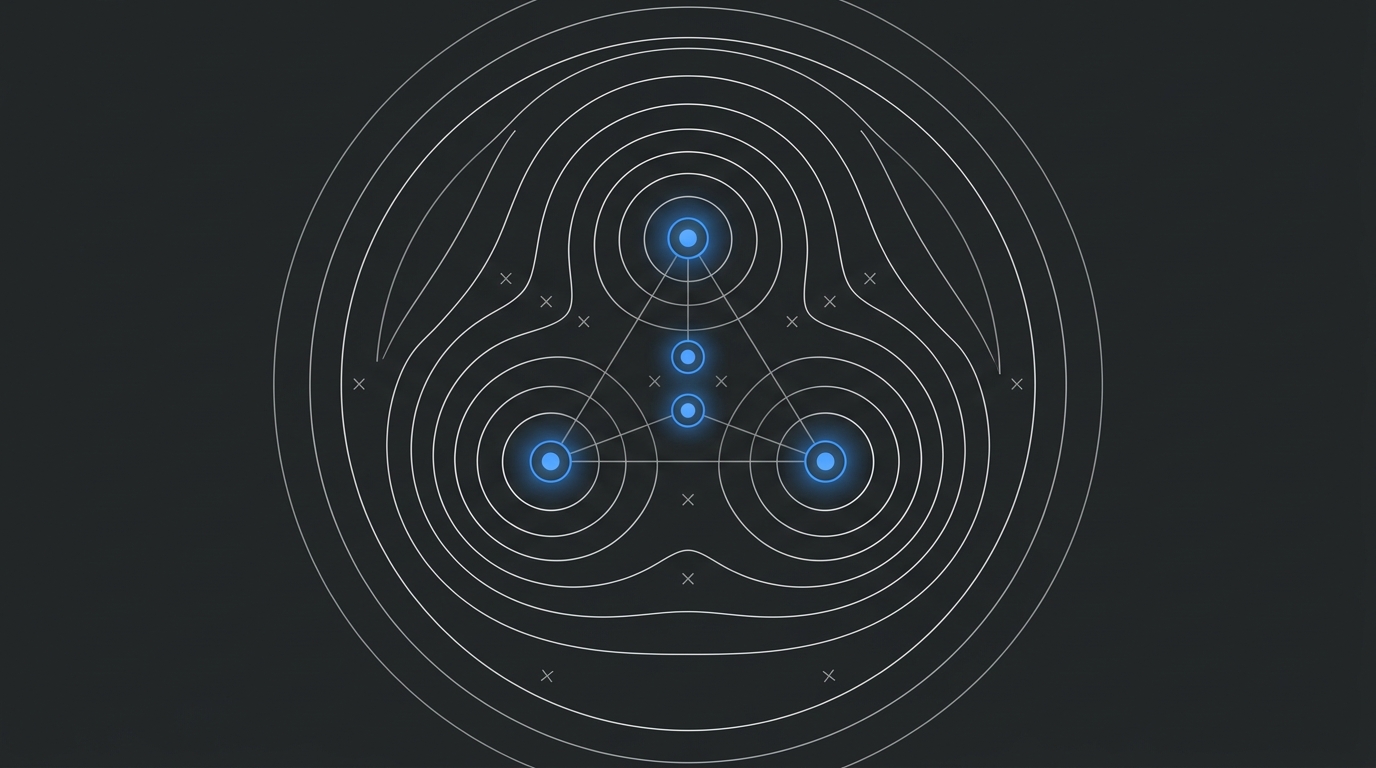
Start with three unit charges at the vertices of an equilateral triangle. That arrangement has 4 equilibrium points: one at the center and three shifted inward, near the edges. Now add two small charges at the center of the triangle and pull them slightly apart along the axis orthogonal to the plane, forming a flattened triangular bipyramid.
The three equilibria near the edges survive the perturbation. The central equilibrium doesn't: it bifurcates into a family of 21 equilibria. Add it up and you get at least 24 non-degenerate equilibrium points with 5 charges — against the ceiling of (5−1)² = 16 the conjecture predicted. Counterexample closed.
This isn't a computer-assisted formal proof, Lean-style: it's four pages of classical math, with Mathematica and Maple checking the numbers. Anyone with a computer algebra system can reproduce the calculations. And that's a pattern that has already shown up here on the blog: the AI results that hold up are the ones that produce an artifact that's cheap to verify.
Second fall in ten days: the pattern
Recap the timeline. July 19: Levent Alpöge publishes a counterexample to the Jacobian Conjecture, crediting Fable 5 with closing the construction. July 29: Arathoon, Ball and Kvalheim take down the Maxwell Conjecture with an idea from GPT-5.6 Sol.
In both cases, the model generated the hypothesis and the human did the proof. In both cases, a counterexample — showing the conjecture is false — and not a proof of it. In both cases, a small, verifiable result.
Greg Brockman, president of OpenAI, celebrated on X: GPT-5.6 Sol "solving conjectures more than 100 years old." The Hacker News thread (125 points, 121 comments) was less ceremonious. The most repeated criticism: these conjectures are available for AI to explore precisely because they're niche — few people working on them, little prestige at stake. One commenter summed up the fatigue: the Jacobian counterexample was big news; before long, "solving Erdős conjecture 7529" won't qualify as AI news anymore. Another pointed out exactly what this post opened with: the formalization is from 2007, not 1873.
Both sides are right, and you can hold both ideas at once. Yes, it's real: a language model suggested a mathematical construction no human had found, and it survived verification by three mathematicians and two algebra packages. And yes, it's niche: it's not Riemann, it's not P vs NP, and the "150 years" is poetic license. What the models are clearing out right now is the backlog of well-posed problems that never had enough people looking at them. That's useful and it's news — as long as it's told at the right size. When Altman said GPT-5.6 had "discovered new mathematics", mathematicians hit the brakes because there was no verifiable artifact. Here the artifact exists: five charges, four pages. The difference between the two episodes is the proof. And the proof was done by people.
Quick FAQ
Is this the same thing as Maxwell's equations? No. Maxwell's equations describe electromagnetism and still hold. The Maxwell Conjecture is a math question about the maximum number of equilibrium points in the electrostatic potential of n point charges. The only thing the two share is the author.
Did GPT-5.6 Sol prove the result on its own? No. According to the authors themselves, the model suggested the idea for the construction. The mathematicians verified the details, wrote the argument in their own words and checked the math in Mathematica and Maple. Without that step there's no result — there's a hunch.
Was the conjecture really 150 years old? The root, yes: Maxwell wrote the remark in 1873, in the Treatise. But the formal statement, with the precise hypotheses, is from 2007 — by Gabrielov, Novikov and Shapiro. Calling it a "150-year-old problem" inflates the result.
Where do I read the paper? On arXiv: The Maxwell Conjecture is False (2607.27197). It's four pages, and the main construction is described right in the introduction.
The takeaway
A conjecture formalized in 2007 fell to a five-charge configuration suggested by a model and proved by three humans. Second time this month with the same pattern — and it's the pattern, not the headline, that says something about your work.
The model has become a generator of good hypotheses. The proof, the verification, the judgment to know when a suggestion deserves a week of attention — that's still human, and it got more valuable, not less. In math, that work has a name: paper. In software it has one too: engineering.
The question that remains isn't which conjecture falls next week. It's whether, when the model suggests the right idea in your domain, you'll have the background to recognize it — and to prove it.

{AI Engineer} — apaixonado por Laravel, arquitetura de software e construir produtos com impacto. Compartilho aqui tutoriais, descobertas e reflexões sobre o dia a dia de engenharia.
There is no shortage of content. What is missing is someone to untangle it: what matters now is how to implement it the right way. In the Clã you get that live, every week, with people who have already filtered out the noise.
Join the Clã